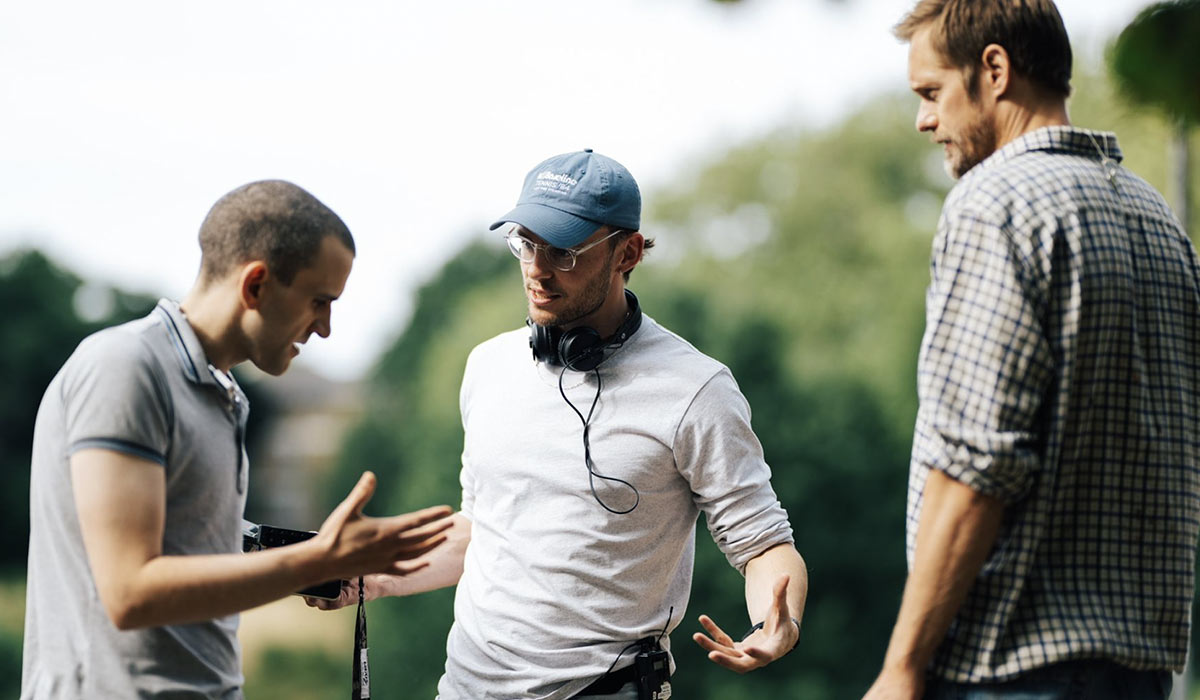
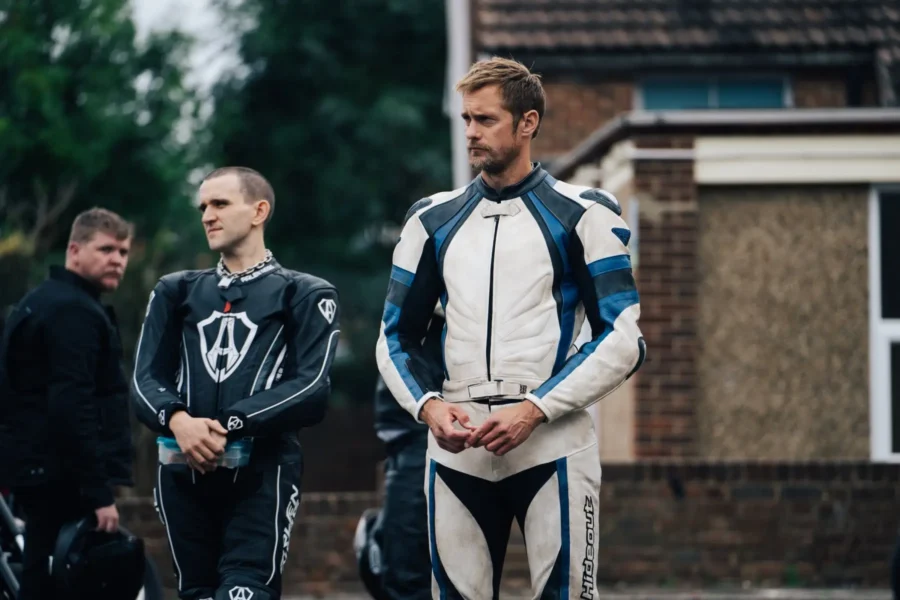
Harry Lighton’s debut feature Pillion arrives with unflinching frankness in its love story of sorts rooted in power and control, resisting easy categorization. Both transgressive and oddly tender, Pillion—adapted from Adam Mars-Jones’ acclaimed 2020 novel Box Hill—traces dominance, submission and personal awakening with deft balance. In the story of a shy submissive (Harry Melling) who finds himself unsettled, and liberated, by a mysterious, commanding biker (Alexander Skarsgård), Lighton allows vulnerability and erotic role-play to occupy the same space onscreen. The result is disarming, to say the least.
I recently sat down with Lighton and Melling at Chicago’s Ritz-Carlton, where they reflected on crafting a relationship that defies rational accessibility—one defined perhaps more by withholding and ambiguity than traditional intimacy. Pillion is a careful negotiation of longing and power with flashes of dry humor and sweetness.
ChicagoFilm: Why this story for you? It’s a challenging subject for a first feature.
Harry Lighton: I think I’ve always sort of been interested in—I wouldn’t say challenging subjects—but this subject is kind of sex which fits outside of the norm. I’d made a couple of shorts—one was about a glory hole and the other was about something similar; so transgressive sex and what that means for the inexperienced individual trying to navigate a world which they haven’t been taught about I think just has an interest for me. And then I got this novel on my desk and read it and thought the added feature of this bike gang and this tone in the novel, where it moves between kind of comedy and sincerity, sometimes within a sentence—it really had all sorts of facets to it, which I thought would make for a very exciting adaptation into a film.
CF: There’s a dry streak of humor running throughout the film, even as it moves into heartbreak. Colin is a character we don’t often see in semi-mainstream cinema. From that early Christmas scene, alone at the back of the bar, he feels untethered, or uncertain of himself. By the end, that seems to shift. What intrigued you about inhabiting a character who doesn’t really have a clear template in prior films?
Harry Melling: I think that was one of the things that really excited me about it. I remember when you presented me the script, you gave me a little letter, and in this letter you wrote something very good that I’m not going to be so articulate saying, but something along the lines of this is a protagonist that we don’t often see because, in lots of ways, he’s quite passive. He’s quite passive to the experience—well, certainly to begin with he’s quite passive—and beta, which again is maybe not a character that we don’t often follow. But all those things are what compelled me and made me want to get involved because, like you said, I think he does go on this significant journey; he hasn’t happened yet, not because of external reasons but internal reasons.
Something in him is not jumping. And then along comes Ray, and he finds a gateway into this world that makes sense to him, and then he’s sort of chasing whatever that is. And then by the end of the movie, I think he has arrived, or landed, somewhere. He knows how he wants to experience love and how he wants to experience this sub-dom relationship going forward. And that is a big journey from inexperience to experience to then knowing how he wants to proceed in life. So, yeah, all those things combined, I think, do make for quite an unconventional arc, but a really interesting, exciting one to play with.
CF: There’s a moment about two-thirds of the way through where he says something like, “I am happy, but I could be happier.”
HM: Yeah. I think he could be happier, which I think is when he starts to understand who he is. I think, yeah, about two-thirds in, something happens. Without giving too much away, his mom is definitely a catalyst for him questioning the boundaries that Ray has established, and him pushing up against them and saying, ‘No, there are certain things that I need in this kind of relationship.’ And you’re right, like, ‘ I’m happy but I could be happier’ is the sort of engine in terms of testing those boundaries.
CF: The word ‘transgressive,’ which you mentioned a moment ago, often comes up in discussions of the film, but so does ‘tender.’ Those ideas feel almost contradictory. Yet the film holds both at once. As I watched the relationship unfold, I wasn’t always sure whether I was meant to feel titillation or something romantic—it seems to intentionally occupy both spaces. That feels like a difficult balance to strike. Was that a conscious tension you were working with?
HL: Absolutely. Yeah. I guess it’d be interesting to me that, in general, when I’ve seen BDSM relationships portrayed on screen, the titillation had been the kind of only note, or certainly the dominant note, at the cost of more complexity. And I think that, as with almost any relationship, once you dig under the skin of the surface, there are kind of competing colors within any kink relationship. And so it was very important to me that you saw the capacity for this relationship to hold contradictions—for there to be tenderness alongside the brutality at times and warmth alongside the coldness. And one of the ways I wanted to do that was by showing that their relationship, while it also has all sorts of different notes to it by the end, it’s not like a blueprint for this dom-sub relationship. You have that other biker pillion pair who do kiss, and you have other pairs who kind of cuddle off to sex. So I wanted to reject the idea that tenderness can’t exist alongside transgression.
CF: The family dinner scene is special because it captures something universal, in that we all hear about our friends’ relationships, but from the outside we can never fully understand them. Colin’s parents are initially supportive, yet they can’t quite grasp the dynamics at play. The film invites us inside a relationship many viewers may not otherwise understand. Also, in 2025, openly embracing such power imbalances can feel political. Do you see the film as offering a kind of window into a world that challenges easy assumptions?
HL: My hope was that there’ll be as many people in the audience siding with Peggy as there are with Ray in that scene. I didn’t want to fall heavily on the side of one or the other because I think that while Ray has a point in that Peggy is applying her own ideas of what a good relationship is to her son, Peggy also has a point in that Ray has lots of blind spots as a boyfriend or a partner by not revealing his last name or what he does. It’s hard to form a kind of long-term, satisfying relationship with someone who holds your arms to that extent. So, yeah, I didn’t want to be too heavily on one side of the fence or the other.

CF: We’re not given a psychological profile or traditional backstory for Ray—none of the usual narrative scaffolding that explains a character. And yet Colin forms an intense emotional attachment to him. How did you approach playing intimacy and longing opposite someone who remains, by design, unknowable—particularly working with an actor who conveys so much with so few words?
HM: I think this was not done by design at all in terms of the way that we entered filming it. We had no time to rehearse. We didn’t even speak before starting to shoot the movie, which I think surprises quite a lot of people because of the content and nature of the movie. You think there would have to be some kind of trust built months prior, but actually that was not done by design. It was done because of necessity because Alex was away shooting something else. So we shook hands and we jumped, and we did the wrestling rehearsal the day before we had to shoot it. And I think for playing Colin that was really useful because it meant that the mystery behind Ray, or the second-guessing his motives, or not understanding him—or, ‘Oh, he’s reading a Karl Ove Knausgård book which means somehow I can glean some information about who he is by reading the same book as him’—those little details meant more because neither Alex nor Harry had told me about those little details.
So it meant that the chase was real in terms of Colin desperately trying to know who this person is and to understand him and get closer to him. And those big milestones, like sleeping in the same bed, mean even more because it’s another inch closer to who this man might be. So I think there’s a thrill in that. I think there’s a real excitement for Colin in not knowing. It was great that we hadn’t mapped out backstories of who these characters were so that all that stuff hopefully could be caught on set in front of the camera.
CF: The final sequence feels almost dreamlike, like wish fulfillment, before it resolves into something more grounded and painful. It reminded me how some relationships can’t survive once the terms shift or move into public space. I once had a friend in a physical relationship with a man who would always wear a mask over his eyes; they never saw each other in public. Once they stepped out to see a movie together, sans mask, and after that they never saw each other again. It was like their contract was over. Was that sense of a spell being broken something you were consciously building toward?
HL: Yeah, I think what you say about the spell being broken is very true, though, that often if you have a relationship which is set up in some way and then you do something which vastly alters the terms of that relationship, when you then try and rejuvenate what was exciting about it previously, it lacks the same frisson. And we deliberately shot that ‘day off’ in a way which is quite distinct from the rest of the film. This feels much more long-lens, documentary-style to try and create a sense of everyday life suddenly impinging on this relationship, which until that point has sort of existed in a goldfish bowl. And Colin doesn’t realize or know until he knows, which always gets to me whenever I watch it, the fact that the story is a bit ahead of him in that little moment.
CF: There’s often discussion about chemistry on screen in intensely intimate scenes. With the artificial nature of filmmaking—multiple takes, crews present, technical issues—given how constructed the process is, in those moments how do you convey something truthful and human and intimate together?
HM: Gosh. I mean, it’s a leap of faith, I guess. You turn up. You’ve got an idea of what you’re saying. You’ve got an idea of what you want to achieve or what you think the scene might be, which it will never be. So you have — it’s a bizarre combination of being very prepared but also surrendering to whatever is happening. And I think in the act of surrender, because you’re obviously listening to another person, hopefully in that act something is happening. And if that thing is chemistry, if that thing is whatever it is, hopefully some of that is getting behind the camera and is available for Harry then to play with in the edit. But it is a bit like a magic trick. And you never know if it’s going to — you have a sense of what the experience was, but you never know until you’re watching it, really, if it’s all going to gel together, because you’re just trying to catch little moments here and there and hopefully that will accumulate to something that is a complete and whole story. But it’s quite hard to talk about because it is so slippery and strange and mysterious.
CF: Over the decades, gay cinema has evolved from the margins where it was outsider cinema into the mainstream, often becoming more broadly palatable—like Heated Rivalry—in the process. This film feels like it pushes into less charted territory again. Where do you see queer storytelling heading? Toward more transgressive narratives, or greater range and variety?
HL: I’m of the opinion that the more varied, the better. Obviously, as a gay man, I want to see as many queer stories on screen as possible, but I also want them not to be flattened into a kind of commercial incentive. I think it’s easy once you’ve seen something be hugely successful—say, Heated Rivalry—to then be like, okay, well, let’s make 20 shows which follow the exact blueprint. And that’s sort of self-defeating because Heated Rivalry was a success because it took people by surprise. My hope is that varied stories will still be getting told. You’ll have a show like Heated Rivalry and something at the complete opposite end of the spectrum.
This interview has been edited for length and clarity.