The most welcome surprise of the 2026 movie year comes in Is God Is, a richly atmospheric tale of vengeance so dripping with attitude and atmosphere it practically oozes off the screen like humidity before a storm. Written and directed by first timer Aleshea Harris adapting her Obie award-winning 2018 Off-Broadway drama, the audacity of this picture—a southern Gothic road-movie about trauma and violent retribution—is that it deftly mixes conventions, genres and purposes to rival the best of 70s grindhouse epics while simultaneously offering a string of engrossing characterizations and very real psychological insights.
In this all-Black ensemble—which includes such heavyweights as Sterling K. Brown, Janelle Monáe, Erika Alexander, Mykelti Williamson and a badass Vivica Fox—Harris has cast a pair of revelatory young actresses in two-time Tony-winner Kara Young and Kindred’s Mallori Johnson, who star as twin sisters shocked after being summoned to their long-lost mother’s deathbed.
They’ll embark on a revenge odyssey to dispatch the father responsible for the trio’s disfigurement in a horrific act of violence decades earlier. The film’s title is deliberately opaque; is it colloquial, broken grammar? Is it a query on the existence of the divine? And if “He” does in fact exist, why would such a father allow near-demonic cruelty?
Northeast officer cleaners and sisters Racine (Young) and Anaia (Johnson) have mastered keeping their heads down; they clean cubicles on the night shift and largely avoid human contact. And while Racine’s disfigured arms and maimed hand can be largely concealed, Anaia can’t hide the scars of her past, written all over a face whose primary features are deep scars and skin grafts.
The sisters share a “railroad apartment” and loyal dependence, and the movie cleverly half-subtitles their conversations, as if speaking telepathically. They also share a terrible childhood trauma, which for Racine (“the rough one”) is made manifest in confrontational bravado and, eventually, a thirst for revenge. Anaia (“the quiet one”), for her part, though externally scarred, has largely internalized her pain and is frightened of the soul-deep consequences of vengeance. After all, God is watching.
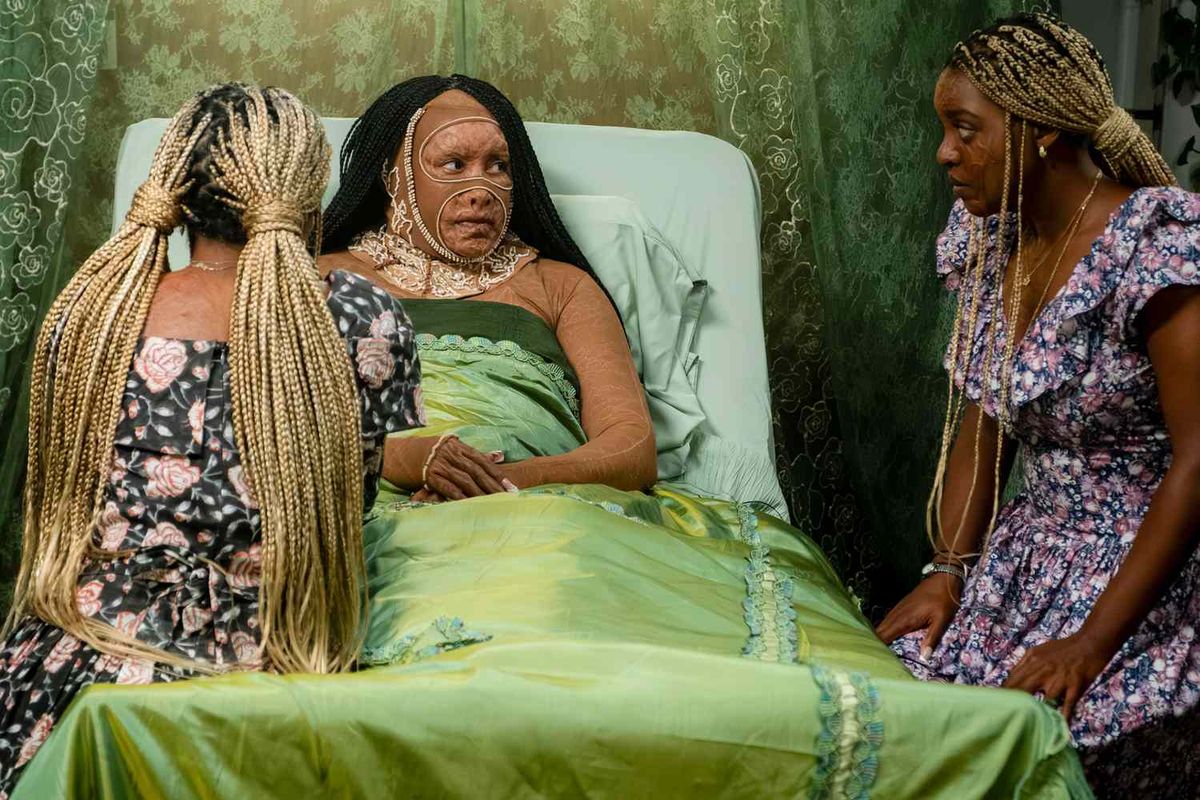
Is she ever. A surprise letter from their believed dead mom (Fox)—known as Ruby the God—spirits the reluctant pair to the deep south (the film was shot entirely in Louisiana), where Harris stages an inventive mother-daughters reunion scene of cold fury; wait until you see Fox, body a twisted roadmap of spousal abuse, hair cooly braided by multiple caregivers, reopening old wounds in a harrowing flashback. Her diabolical, dying wish? That Racine and Anaia eliminate their long-gone abusive father.
Simple, right? Not quite. This violent odyssey leads both women (and us) down impossible-to-predict rabbit holes across dad’s demented past en route to a climactic reckoning; my jaw was slack as Harris upped the ante from scene to scene in her episodic, exciting movie, one that builds with the ferocity of a gathering storm.
Harris shuttles us from one colorful sequence to another—Alexander as a fiery Pentecostal minister named “Divine the Healer,” given to cultish sermons and long devotion to her monstrous ex; Williamson as a lawyer muted by a mutilated tongue, issuing written warnings via a notepad (“Be careful with vengeance; one doesn’t know where the blood will land”); and an elegant Monáe as the refined, gilded-cage new wife, trapped by coercion and protective motherhood.
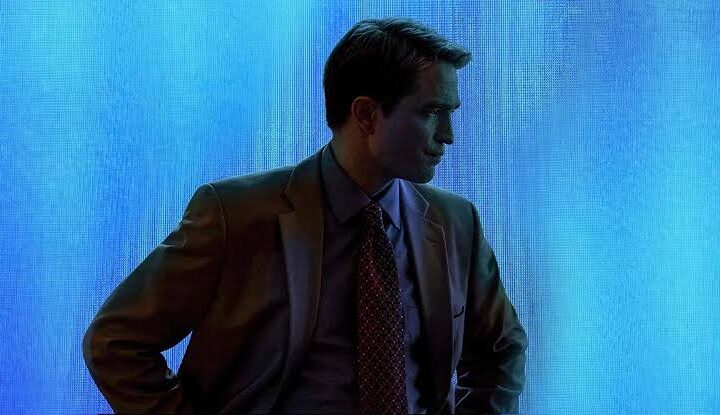
When American Fiction Oscar-nominee Brown finally shows up, he gives the movie’s final stretch one of the most dangerously charismatic, sinister screen villains ever; this is what a great actor can do. After much expositional build-up, the handsome actor presents a calming, deceptively paternal, near-plausible rebuttal to his long-architected legend; in a stunning scene of knife-edge tension, Anaia and her father (known as “the Monster”) come disturbingly (and fleetingly) close to tenderness. Here, the movie achieves its apex in scriptural allusions in a father figure more satanic than divine—not a guardian but rather an architect of their ruin.
To say more would betray Harris’ superbly keen balance of B-movie revenge thrills and very serious consideration of patriarchal abuse and manipulation; “the Monster” is symbolic but clearly recognizable—the father as a cold-blooded psychopath of little conscience and ever-present ghost, leaving a self-defining imprint on his victims, as if a curse that can’t be counseled away because he has twisted his victims’ bodies in his image.
Harris’s impressive attunement to character shifts creates an enigmatic psychological puzzle between her leads, who indulge in very different coping strategies. While the women are initially polar temperaments but simpatico, their pursuit of vengeance changes both, especially the hair-trigger Racine, whose internal trauma is given license to become, for once, rage unleashed (her code of “justice” also lacks conscience). But during a key late scene where an innocent character is shockingly killed, and another, in which an unlikely ally seems to emerge, the sisters will diverge—Anaia’s core sense of human morality starkly contrasts Racine’s belief that trauma can be soothed through bloody retribution.
Is God Is is a shamelessly entertaining, outrageous, pulpy revenge movie with one foot firmly in overheated 70s exploitation (including the luscious, supersaturated, high-grain widescreen lensing by Alexander Dyson) and another that is deadly serious about intergenerational scars, sibling symbiosis, the pain of growing up an outsider, and legacies of abuse. Every supporting character, performance, and set-piece (including a terrifying, helmeted motorcycle killer and a sexed-up striptease power game) takes the movie to a new level, and editor Jay Rabinowitz moves at such a clip as to leave not an ounce of fat on the film’s efficient, 99-minute bones. It is lurid, ridiculous, deeply sincere, and slightly profound—and damned entertaining in a way few movies today even attempt.
It’s a knockout.
4 stars