Bitingly funny and tragic to the core, Our Hero, Balthazar walks a knife’s edge of absurdist social critique and dead serious pathos as the year’s ballsiest, most original movie. From co-writers Oscar Boyson, who also directed, and producer Ricky Camilleri, it’s a bleak provocation about a brief best friendship between two diametrically opposed young men—one a performatively detached, affluent Manhattan teen, the other an aggrieved young Texan teetering toward violence. Both are loners in the Manosphere, which makes for a movie odd couple of raw, unsettled anxiety.
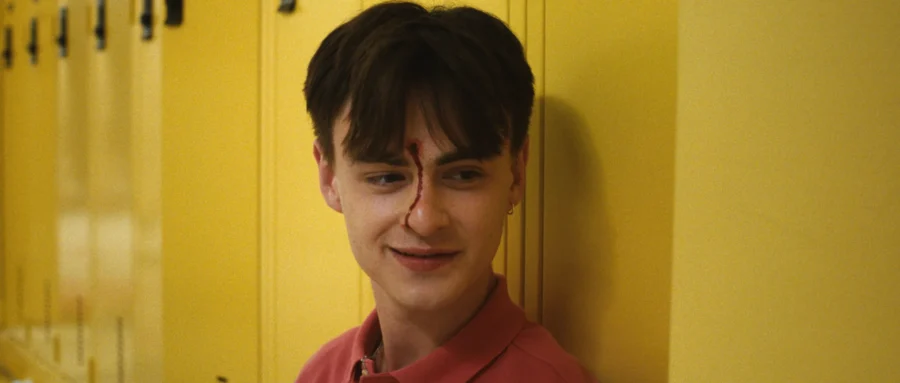
From the moment we meet Balthazar “Balty” Malone (Jaeden Martell), a wealthy prep school brat with an absent father and neglectful mother (Jennifer Ehle), his feigned despair in posting reels about school violence is unapologetically, bitterly funny; the super smart Martell’s labored crocodile tears are a taboo hoot—even if the notion of a virtue-signaling social conscience masking aloof disaffection is anything but. So is his thwarted courtship of “activist” scholarship student Eleanor (Pippa Knowles), the pair playing bloodied “victims” in a meet-cute school shooting drill; things go south after Balty makes a clumsy advance using explicit carnage footage as a turn-on. Yes, really.
It’s not just Eleanor who dumps Balty; his mother also disappears during his birthday weekend in favor of dubious politician boyfriend Hakim (David M. Raine), leaving dejected Balty in a dark web catfish scheme sexting a budding future school shooter. His horny, hot-to-trot avatar (complete with gleefully profane dirty talk assisted by his mother’s AI voice) immediately hooks the would-be gunman, but his preposterous plan to stop an impending school tragedy is merely another calculation to capture Eleanor’s affections.
That fledgling future assailant is revealed as down-on-his-luck Texan Solomon Jackson (Asa Butterfield), who lives with his debilitated grandma (Becky Ann Baker, making the most of every line) in a run-down Arlington trailer while blowing his cash on a men’s virility supplement marketing scheme fronted by his deadbeat ex-porn star father Beaver (Chris Bauer).
It’s all going south for poor Solomon—cruelly rebuffed as an “incel” by a pretty coworker (Anna Baryshnikov), he loses his convenience store job, falls thousands behind on rent and is going nowhere; worse yet, no one cares. That is, until he meets his catfish buddy Balty, who arrives in the Lone Star State just in time for the pair to establish their first real friendship. Or do they?
Boyson and Camilleri push their two young men into a keep-you-guessing interdependency. Solomon is as lonely an outsider as the movies has seen in some time, with a voracious need for someone—anyone—to see him. No matter that Balty’s attentions are predicated on deception: “He’s my friend,” Solomon keeps declaring, a pathetic self-worth validation that seems, for a moment, a lifeline.
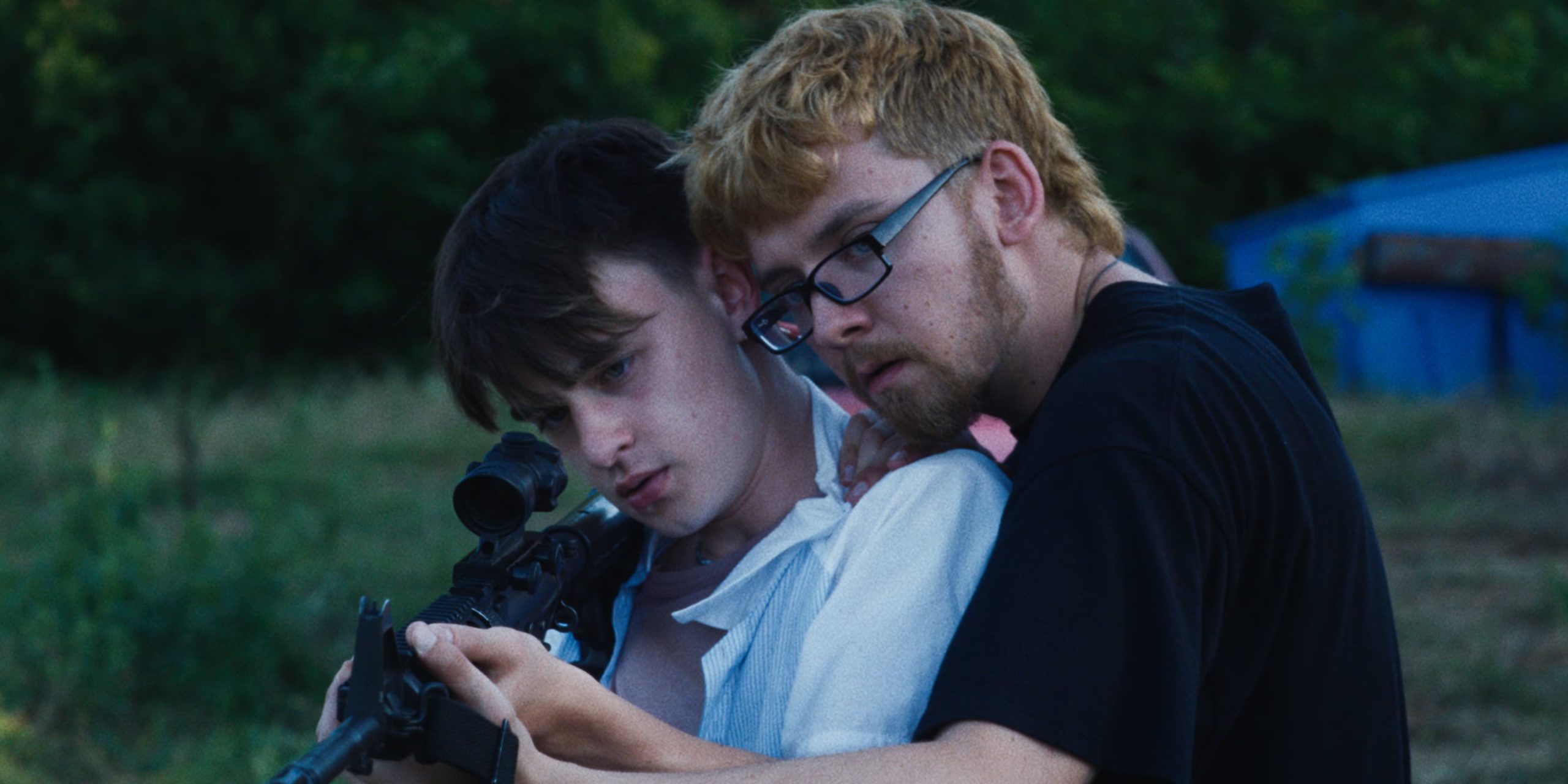
And insulated Balty gains an uneasy clarity after bonding during a suggestive moment at the rifle range—what it feels like to actually fire a gun in its strange aliveness—and a growing suspicion that his new friend (who has meticulously laid out blueprints of the local school and amassed an arsenal) may be just as performatively constructed as he himself has been (though perhaps less intentionally). How Boyson and Camilleri resolve this, in an explosive shock denouement and icily cynical final moment, almost returns the film to its starting point, with Balty’s attention-seeking (or are they?) antics going mainstream.
In Our Hero, Balthazar, Safdie Brothers producing alum and first time filmmaker Boyson (Good Time, Uncut Gems) and co-creator Camilleri mordantly essay a pair of inseparable social hot buttons, taking on America’s gun-centric culture and the epidemic of loneliness and anxiety in young American men today—a combustible mix—with more than a dash of addictive online compulsivity. Yet instead of pat solutions they aim to provoke; their movie is better for it.
Both Martell (Midnight Special) and Butterfield (Hugo) are scene-for-scene superb, Martell meticulously conveying both indifference and manipulation (he reminded me at times of a latter-day Bud Cort in Hal Ashby’s 1971 classic Harold and Maude) in a way that’s often impossible to read; his jaded anarchy is riveting. And Butterfield, wounded heart on his sleeve, humanizes the archetype of a social media troll turning toward anger in lieu of a support network. Special mention to Noah Centineo in a single comic scene as Balthazar’s hired “life coach,” but not intellectual equal.
The picture is polished in handsome widescreen by DP Christopher Messina (If I Had Legs I’d Kick You) and scored to perfection with electronic propulsion by James William Blades. And credit the smart screenplay for assuredly integrating its pair of offbeat co-lead characters of different worlds and temperaments—a portrait of two teenage anarchists, if you will—with illustrative clarity of purpose. There’s a special delight in a film that sustains charged unpredictability for its entire running time, and Our Hero, Balthazar, the rare American film with something to say, never lets us settle.
4 stars