In Blue Heron, Canadian-Hungarian filmmaker Sophy Romvari excavates a powerful, semi-autobiographical family history through memory and form. It’s a movie about reconciling childhood and loss through fragments to understand a trauma that, from a child’s view, felt incomprehensible. Only decades later can the full weight of a tragedy come into focus in Romvari’s devastating act of reconstruction.
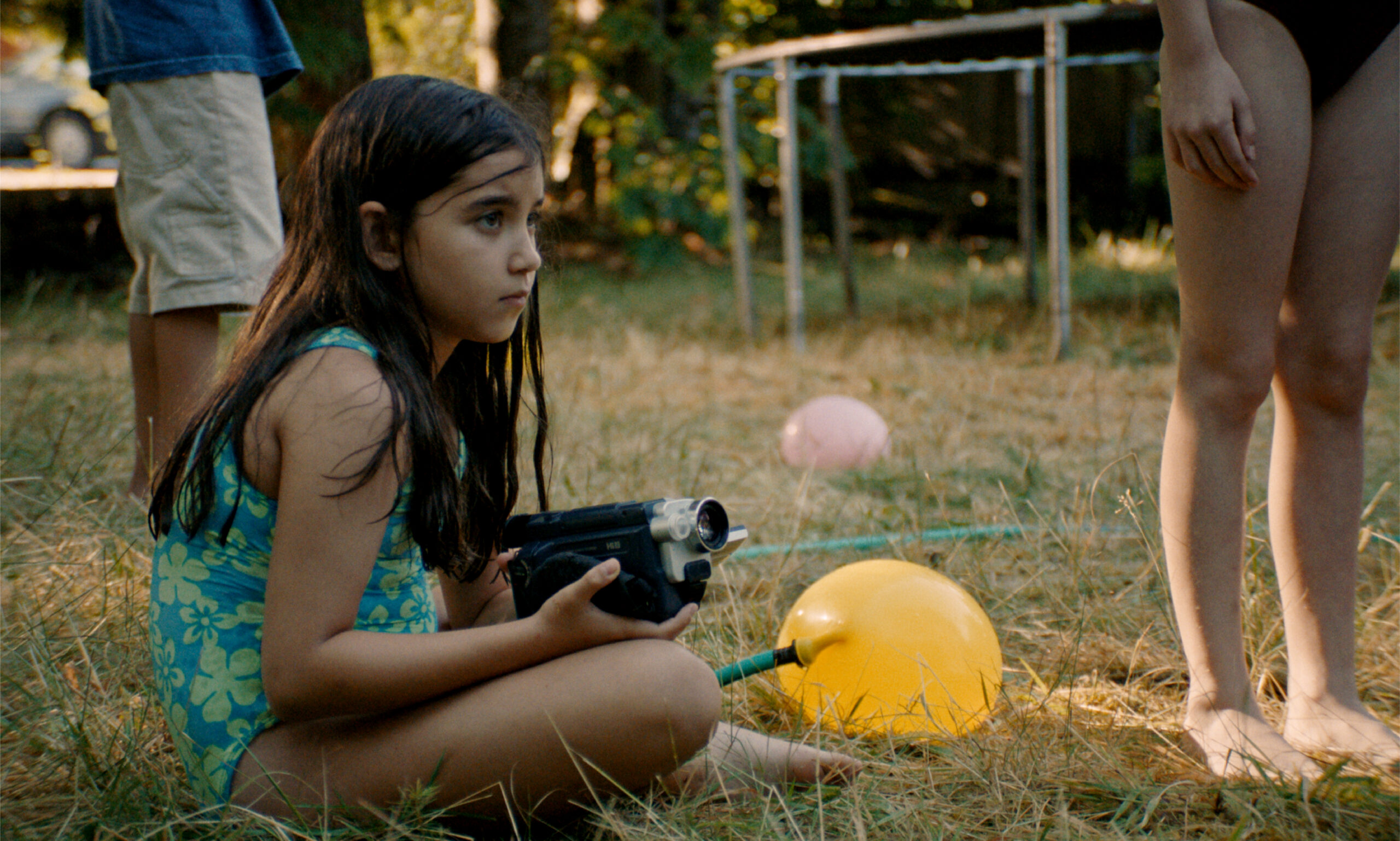
In her debut feature’s quiet opening sections, Romvari establishes a deceptively lyrical spell—one she will progressively undermine—as a family settles onto Vancouver Island in the late ’90s. Told largely through the wide eyes of nine-year-old Sasha (the expressive Eylul Guven, holding the frame), her Hungarian immigrant parents, by way of Canada, become increasingly concerned with her wayward half-brother Jeremy (Edik Beddoes).
Not a day goes by without a struggle, whether corralling Jeremy for family beach outings (where he sits alone on a cliff) or wrangling him after a disappearance. With three other children to tend to, their exasperated mother (Iringó Réti) and stepdad (Ádám Tompa) try to connect with the troubled teen, whose anarchic withdrawal initially registers as typical rebellion. But Jeremy only seems to drift further, isolated in his bedroom (or asleep on the front porch) where he crafts intricately detailed island maps.
While Jeremy is gentle with his siblings, defiance turns to deeper disturbance when he’s apprehended shoplifting before recklessly endangering himself atop a roof. Romvari acutely documents the parents’ bewilderment as run-of-the-mill acting out becomes far more serious—perhaps “oppositional personality disorder” as suggested by a local child psychologist. Meanwhile, carefree Sasha and her two other brothers can’t grasp the gravity of Jeremy’s destabilization.
Romvari subtly shapes a world of hurt—a mother and daughter preparing dinner together, the mother a thousand miles away; parents speaking in hushed whispers about unhelpful family counseling while frightened of things to come; a father and son physically fighting toward a restraining embrace; and Jeremy himself, an enigma acted by Beddoes as if trapped in a privately volatile world, masked by bottle-thick glasses that place him at an even greater visual remove.

While Sasha’s mother rebuffs her suggestion to have friends over out of concern for how the community will perceive Jeremy’s already talked-about obstinacy, Sasha herself is insulated from his behaviors—either by distance or outside windows contemplating hushed phone voices—and Romvari frames her as if peering in, piecing together what cannot be spoken aloud.
In the film’s second half, Blue Heron takes a striking narrative leap (and asks the audience for a leap of faith), flashing forward decades where adult Sasha (Amy Zimmer) has become a documentarian still trying to understand the whys of Jeremy’s fate, assembling a team of mental health experts to review his case file and assess whether contemporary approaches might have yielded a less tragic outcome—or perhaps not.
A storytelling masterstroke finds adult Sasha appearing to revisit her childhood home, imagining herself as the social worker whom, as a child, she only peripherally observed. In a heartstopping sequence, she sits beside her younger self before conducting a parental visit to consider a possible foster care solution for Jeremy.
The film’s ingenious poster depicts the family on a happy afternoon outing, its paper ripped down the center to suggest a ruptured, open wound. And more than once during Blue Heron, I was moved to tears in Romvari’s sobering contemplation of how some wounds deepen with time rather than heal. Her structural audacity depicts the coexistence of past and present as a non-linear memoryscape, most effectively in a heartbreaking exchange as adult Sasha finds a measure of comfort in reading an aged letter, her long-deceased brother sitting beside her.
While most of the movie is told from young Sasha’s perspective, Romvari—who based the film on her own experiences and late brother—moves fluidly to the parents’ struggle, and ingeniously to her docu-like investigation where Sasha’s child and adult identities merge; her movie seamlessly balances these points of view and its structural daring without ever stepping wrong.
Romvari directs Blue Heron without an ounce of melodrama (in tone, similar to Charlotte Wells’ Aftersun but, for my money, more gripping). After a festival run last year, Janus Films has given the film a limited theatrical release, and it is an essential moviegoing experience.
4 stars