After the Hunt, Luca Guadagnino’s portentous drama about a Yale professor caught up in a campus scandal, is one of the year’s big disappointments—an overwritten discourse that wastes a terrific cast by mistaking culture-war talking points for character, and topicality for drama.
Nora Garrett’s zeitgeisty screenplay must have sounded juicy on paper: a beloved academic unravels after a star student’s assault allegation against a longtime fellow professor. That these three characters are played by Julia Roberts, Andrew Garfield and Ayo Edebiri should have made for gripping drama. But sociopolitical warfare alone is not drama, which requires recognizable humans, and After the Hunt is so consumed with its subject that it mostly reduces its people ideological mouthpieces.
In the picture’s opening sequence, we meet Roberts’ Alma Olsson, hosting a social soiree with psychiatrist husband Frederik (Michael Stuhlbarg). It’s the sort of Ivy League academe affair that’ll set the tone for the movie, one where the long-married hosts debate familiar identity politics: “When did offending someone become a cardinal sin?” and “The common enemy has been chosen, and it’s the straight, white, cis male.” The movie believes this to be crackling dialogue, but such topics as cancel culture, privilege and identity are everywhere today; Garrett’s conversation is less intellectual elite and more patly common.
Guests include Alma’s close friend and fellow professor Henrik Gibson (Andrew Garfield, underused) and the purportedly brilliant (we see no evidence) Maggie Price (Ayo Edebiri), who as a Gen Z lesbian of color dating a trans man stacks the movie’s already contrived agenda. Maggie isn’t quite on the same ideological page as her mentors, and the movie makes her integrity dubious after she steals a photo from Roberts’ home. The next morning, trouble erupts when Maggie accuses Henrik of assault. But where does the truth lie? Could it have something to do with Maggie’s fixation on Alma? And what sort of fixation might that be?
Alma has her own demons, including a decades-buried secret telegraphed early and clearly added to the story as if to seem provocative; at least it gives Roberts some dramatic notes to play (including a late scene in a hospital that finally says something interesting). Her marriage to Frederik seems headed for trouble; he observes her as a narcissist who thrives on student adoration. Both Alma and Henrik are up for tenure—any guesses how that plays out? Roberts, returning to the screen in solid form, is the best thing in After the Hunt, but her secretive character blunts her signature effervescence.
Guadagnino capably dresses up Garrett’s muddled script, which trots out plentiful digressions and suspicions around who is telling the truth (even Alma also proves herself a schemer). But it is all too much and not enough. Narrative detours muddy the drama, from Alma’s prescription drug habit to her incapacitating stomach pains (which, naturally, get more violent as the plot thickens).
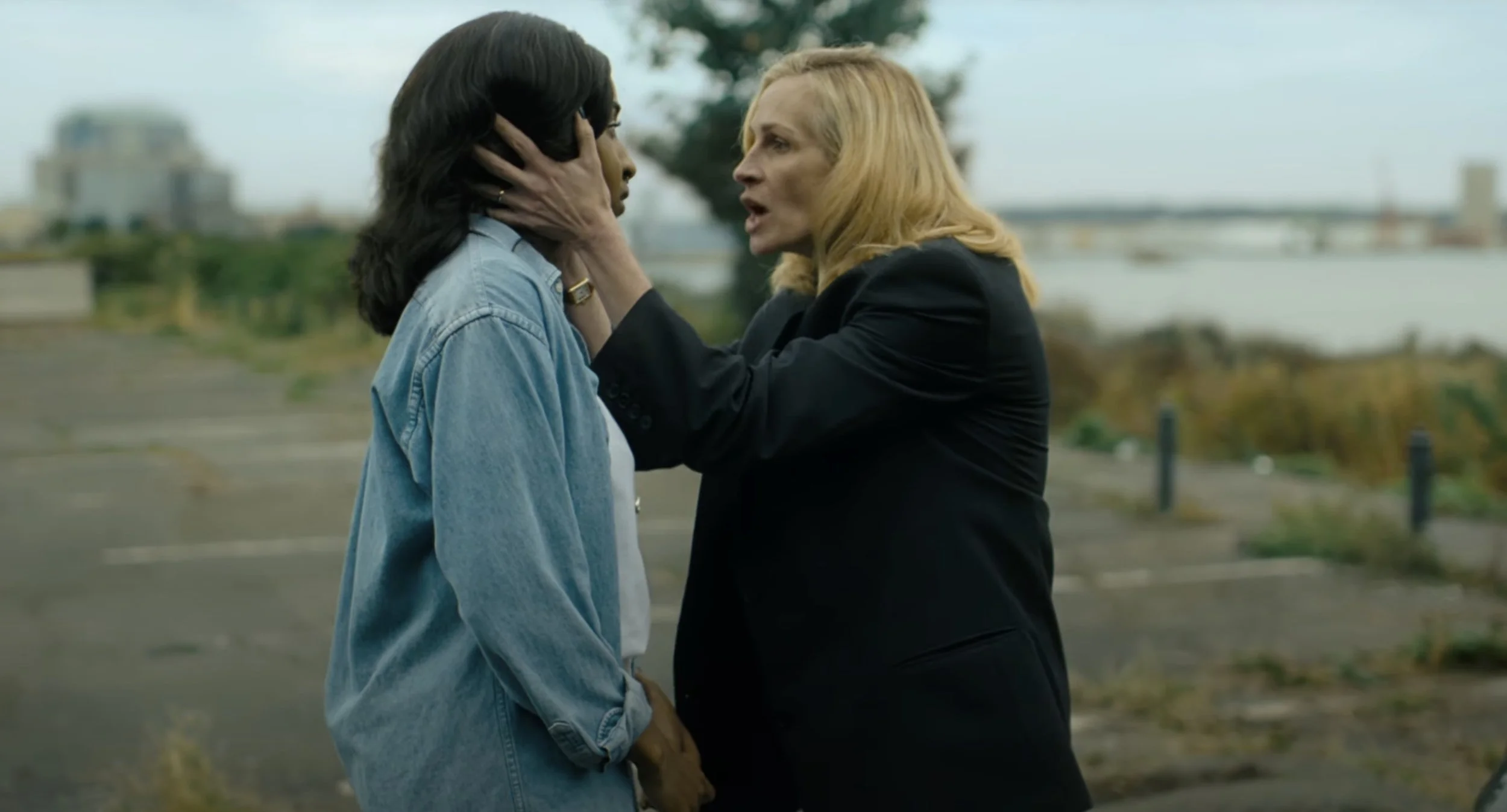
As on the nose as much of this is, key areas are opaque. The film never clarifies what it wants to say about Alma and Frederik (Stuhlbarg, usually excellent, overplays every scene), but does toss in a pointless red herring in a late confrontation between Alma and Henrik, which contains two unsurprising revelations. Even the tense scenes between Alma and Maggie, physically volatile and emotionally manipulative, feel rote and serviceable.
It doesn’t help that Guadagnino stages his key confrontations in awkward, direct-to-camera close-ups, as if the characters were unloading their grievances on the audience. Whatever the intention, it looks amateurish. And Trent Reznor and Atticus Ross, two of today’s best film composers (their score for Guadagnino’s Challengers was 2024’s finest), contribute a discordant series of soapy, too loud arrangements that frequently drown out the dialogue. This “music as character” approach worked in the propulsive Challengers but here feels incongruent; on the plus side it saves us from enduring at least some of the lecturing.
A bright spot arrives in the form of Chloë Sevigny as the dour university psychologist, and she gives a wry performance, making the most of every glance. A scene between her and Roberts in a local bar where The Smiths’ music (Heaven Knows I’m Miserable Now) plays in the background (perhaps a sly nod to Morrissey’s conservative politics?) is one of the few that actually breathes.
But just wait for the picture’s ludicrous coda, a “five years later” epilogue where two characters who have spent the bulk of the film in acrimony suddenly appear on good terms—despite one ruining the other’s reputation and possibly career with a savage, Rolling Stone exposé written and published overnight, based on one-sided accusations and without so much as a quote from the accused. Certainly, many livelihoods have vanished without due process in the #MeToo era, yet the way Guadagnino and Garrett resolve their thorny central relationship feels implausibly expedient, to say the least.
After the Hunt plays like a catalogue of bait buttons—gender, race and power imbalances, generational divides over “wokeness” and the perils of political correctness (the film itself is a swipe at “believe all women”). But such headiness feels contrived to Make Big Statements, and lands nowhere near the intelligence of the generational debate warfare Cate Blanchett memorably waged in Tár’s best scene.
For all its provocations, After the Hunt is bloodless off day for the very talented Guadagnino, an otherwise nuanced, sensitive storyteller and high-grade stylist whose resume includes such bonafides as I Am Love, Call Me by Your Name, Challengers, Bones and All and Queer. This time he lost his footing in a project where the ideas mattered more than people.
1 1/2 stars