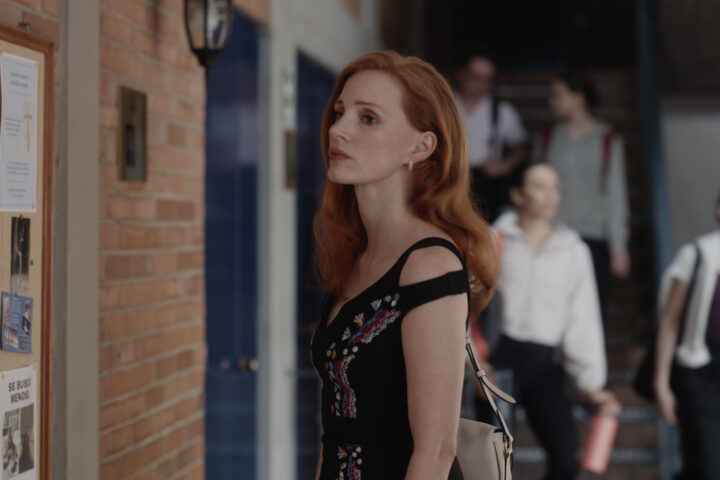
Hamnet arrives in theaters with quite a reputation preceding it—that of a movie with such elemental power that it shook fall film festival audiences to their cores, awash in tears. But does the power to make an audience cry—that primal, communal catharsis that movies today rarely attempt to accomplish—make Hamnet a uniformly strong drama, or merely one that leaves you with a thunderbolt of feeling?
A Shakespeare origin story, Hamnet frames the young Bard’s creation of Hamlet as a testament to the healing power of art. And in this tale of shattering family loss, there is a lot of healing to be done. Oscar-winner Chloe Zhao’s picture, based on Maggie O’Farell’s 2020 historical fiction novel, is handsome, lush and emotional intimate courtesy of the heartrending Paul Mescal and Jessie Buckley, a well-matched double act in young love and later, tragedy.
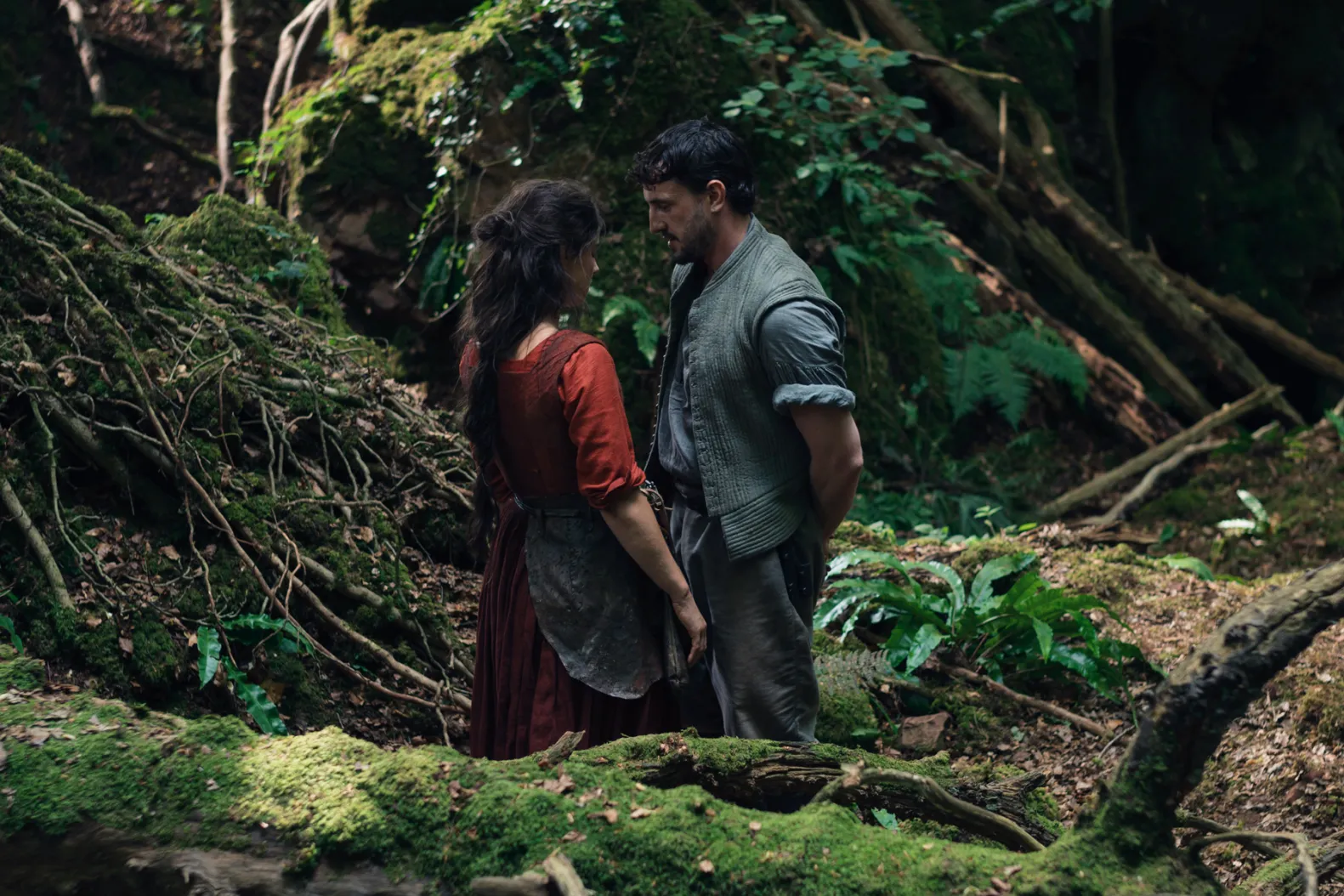
The picture opens at the edge of a deep forest, where we meet Agnes (Buckley), a sort of naturalist earth mother whose own late, spiritualist mother raised her in tune with the woodlands, lies fetal near a forest floor opening and keeps friendly communion with a wild hawk. Zhao expertly mounts this woman-nature harmony, taking time to establish nature as a place where Agnes, a kind of herbal sage, quietly and slowly moves through it in long, evocative shots.
In such rarified, Stratford-upon-Avon locales (shot in Weobley, Heefordshire) Agnes meets new Latin teacher William (Mescal), instantly smitten and who disarms her confidence with a wry flirtation; both actors have real chemistry in a low-key, period believable courtship. Soon enough Agnes is pregnant, and to the disapproval of William’s stern father (David Wilmot) and skeptical mother (a fine Emily Watson), the couple moves into the family home. On her side, Agnes has no kin except faithful brother Bartholomew (Joe Alwyn), but soon after gives birth to daughter Eliza (Freya Hannan-Mills), followed by twins Hamnet (Jacobi Jupe) and Judith (Olivia Lynes). For a good while, things are happy.
But familial bliss ruptures after William essentially moves to London to become a playwright, returning only periodically. Here Mescal largely cedes the movie to Buckley, who very effectively depicts young matriarch Agnes’ missing her husband while finding her hands full with three young children. A small resentment festers, one set to explode after the dreaded bubonic plague intervenes with harrowing cruelty.
At this point, a spoiler warning is in order as the movie mounts a sequence so wrenching in its agonizing depiction of child mortality it is practically wounding in force. That child, the preternaturally sensitive Hamnet, is played by an astonishing young actor named Jacobi Jupe, whose rare sensitivity—watch how he plays a scene as dad William departs for London, a moment Zhao superbly shoots in an overhead master—is presented as a highly intuitive emotional intelligence. As Hamnet naively offers his own life to save his ailing sister, Jupe’s gives one of the year’s exquisite performances.
Buckley, unleashing a torrent of sorrow and pain worthy of a Greek tragedy, plays Hamnet’s fate with such agony as to be overwhelming. This is the stuff of nightmares, a child dying horribly in one’s helpless arms, and the movie pulls no punches about its devastation, which draws a line in the movie and Agnes’ existence. This loss is made tenfold in that William arrives only in its aftermath, increasing estrangement.
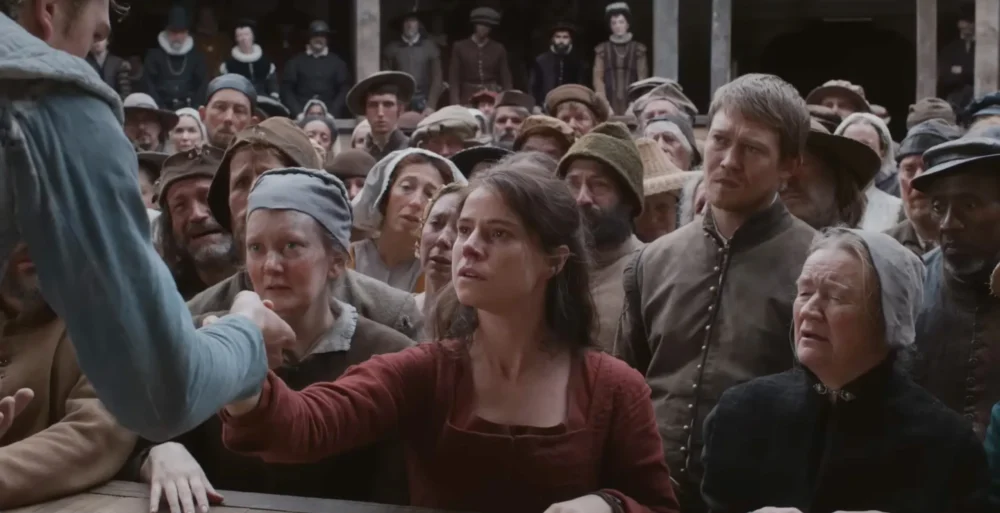
Like several other films of late, including Sing Sing, Ghostlight and this season’s Sentimental Value, Hamnet is about how an act of artistic creation becomes functional healing in its merger between real life and artifice; if grief is the catalyst, art transfigures human pain into meaning. Instead of coming together, William and Agnes drift further, but in the film’s later stretches she ventures to London and finds herself enraptured (as are we) by both the newly constructed Globe Theatre (the production team purportedly built a specially scaled replica 3/4 in actual size) and discovery that her husband has become a major artist, one who has been no less overwhelmed by sorrow but has channeled it into a new play, Hamlet, which you’ll not think of the same in the future after seeing this film.
Zhao, whose in pictures like The Rider and Nomadland harnessed real life people to achieve impressive emotionality through ordinary life moments, had a career misstep with the Marvel failure Eternals (a Sisyphean effort she endeavored to personalize). Here she stretches into new, enveloping territory once Agnes enters the Globe to discover the debut performance of William’s new play, and Buckley’s open-souled approach to the moment—initially bewildered by the setting and theatricality, seeming not to distinguish life from drama, making her way through a throng of unwashed masses to stage’s edge—sends the movie to the stratosphere.
During this stretch a sublime Noah Jupe (A Quiet Place), older brother of young Jacobi and playing Hamnet’s fictional, elder alter-ego Hamlet, interacts onstage with the ghost of his father, played strikingly by Mescal’s painted white William, and this interpretation of the ghost—suggested to be the original one—is like none other. In this sense, the ghost is retrofitted to suit the movie’s (which is historical fiction, after all) tender, dramatic need.
For Agnes, the meta-impact of the moment provides an opening, as she hangs on every word of Hamlet’s soliloquy. Here the deceased Hamnet also seems to show up onstage, and how Zhao stages all of this is perhaps one of the best mounted art-life allusions ever. During a powerful backstage moment Mescal does his most emotional acting, alone in contemplation of William’s regrets, working through them as if via exorcism through craft.
But it’s a simple exchange from Agnes at the end that creates a bridge between spectator and star, and between grief and healing. This is an important idea and the reason why we go to plays and movies, to experience together, performer and patron, an exchange of energy and feeling. When Agnes reaches her hand out to the dying Prince Hal, it’s an opportunity to once again touch her doomed son; perhaps even a proper goodbye. But it’s also about what an artist needs from his audience—you hear live theater actors talk about this all the time—moments of genuine transference.
Without this extended sequence, Hamnet’s point might be diminished and accusations of high art “grief porn” might have small merit (though the film is much too artistically distinguished to be so easily assailed) as everything before this moment is but a careful prelude to Zhao’s masterstroke emotional release, mending a family’s brokenness and celebrating the act of creation. Composer Max Richter contributes a slight misstep by using (again) his now familiar On the Nature of Daylight during the picture’s climax, undermining our immersion. A composition that’s been heard in no less than seven films, including Disconnect, Arrival and Shutter Island, it’s time to retire this admittedly emotional track given its strains now recall so many other film experiences.
Throughout Hamnet, Buckley, so good in so many pictures from Wild Rose to The Lost Daughter to Wicked Little Letters, dominates the screen with such raw intensity that she seems poised to cut through the noise of awards season and walk straight to the Oscar stage, just as Agnes has done at the Globe. Her exquisite performance reminds us why art matters.
3 stars