There will be little middle ground on James Cameron’s thrilling Avatar: Fire and Ash; you’ll either find it richly transporting or, well, expected. Perhaps both. Sure, it’s what you think it is—a battle royale between tall blue beings and colonizing invaders loaded with dazzling design, driven by as many family, environmental and spiritual notions its whopping 197 minutes can support (and even some it perhaps can’t). But if Hollywood movies are still at all about wonder and escape, few films reach this high or even try.
By now, Cameron’s innovative magnum opus trilogy chronicling family and warfare amidst the lush, alien moon Pandora, its towering blue eco-warriors in a perpetual struggle against human imperialism, is practically cultural shorthand. In 2009’s Oscar-nominated Avatar, Cameron arguably redefined movies, unveiling immersive motion-capture 3D techniques in a magician’s work of such otherworldliness it dwarfed all other studio movies that year. And in 2022’s Avatar: The Way of Water, Cameron pushed further, giving us a spectacularly conceived undersea ecosystem and, yes, mystical fighting whales which he rode to a Best Picture nod.
Sixteen years since inception, it remains to be seen whether 2025 audiences will have Avatar conceptual fatigue or push the film to individual $2 billion box office tallies of its predecessors. Regardless, in every frame of Avatar: Fire and Ash Cameron has again pulled out the stops to craft an experience of such roaring, maximalist intensity that it’s impossible (or disingenuous, perhaps) not to be wowed. As the series’ narrative and action apex, the picture is mounted with the kind of gargantuan scale of which only Cameron can conceive.
A direct continuation of Avatar: The Way of Water, Cameron and co-writers Rick Jaffa and Amanda Silver give the picture minimal set-up, plunging straight into heated family dynamics as the Sully clan mourns the battle death of son Neteyam (Jamie Flatters). Sam Worthington returns as patriarch Jake, whose relationship with surviving son Lo’ak (Britain Dalton) strains amid questions of responsibility, while Zoe Saldaña’s earth mother warrior Ney’tiri suffers an emotional crisis trying to hold the family together. Everyone is under intense duress while remaining with the Metkayina tribe in their elaborate beachside hut community, again led by Tonowari (Cliff Curtis) and Ronal (Kate Winslet).
As tension builds within the family and between the tribes, the ever persistent humans in the floating RDA command center are still seeking to transform Pandora for habitation, and baddie Colonel Quaritch (Stephen Lang) returns for round three. Meanwhile, Neteyam’s death creates an emotional projection of distrust in for Ney’tiri, who wants their human “son,” Spider (a strong Jack Champion), removed from the picture and returned to the RDA.
This becomes a major point of contention for the younger characters, who have bonded with Spider, including a budding attachment to Sully daughter Kiri, whose Na’vi incarnation is voiced by Sigourney Weaver. The voice can feel slightly out of sync with a teenage character, though the first film establishes that Kiri’s formerly human counterpart, scientific researcher Dr. Grace Augustine, was also played by the live action Weaver.
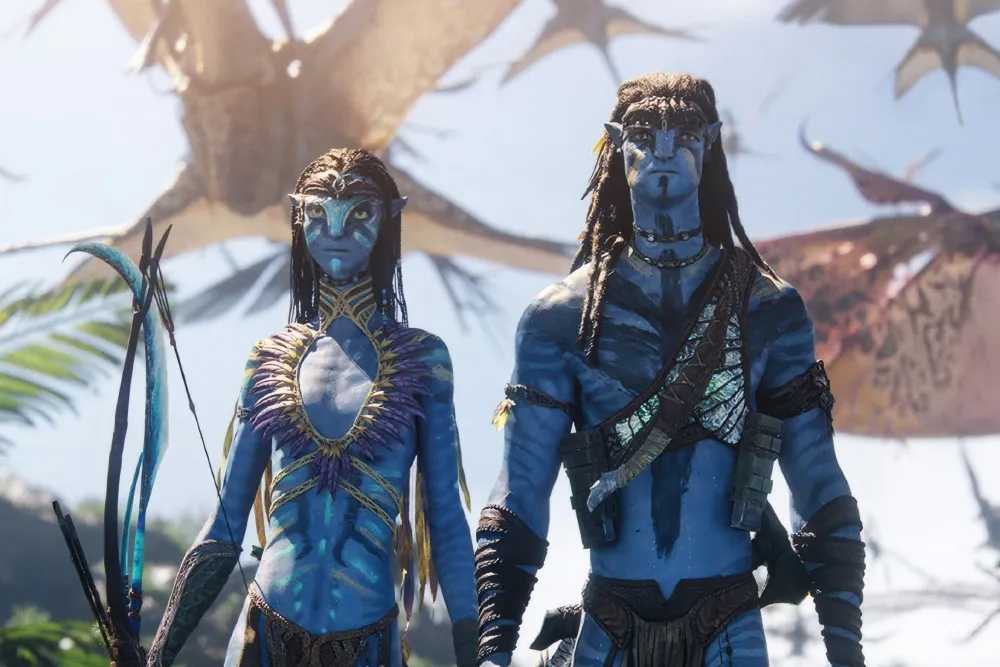
The Sully’s plan is to quickly turn Spider over to the RDA, but things take a wild turn on the introduction of a feral villainess named Varang (Oona Chaplin), ruler of a fiercely brutal colony of white-painted Ash People. Cameron clearly has fun with them visually, essentially a scorched mirror of Jake’s clan. The visualization of their warrior society, including a terrific scene in which Quaritch arrives and naturally finds himself simpatico with Varang, is a standout; they make quite a pair. Spanish-Swiss star Chaplin is a sensationally menacing presence onscreen.
The central dilemma—whether Spider will remain with the “Sullys stick together!” clan or be cast back to his evil father, Quaritch—becomes a major fault line between Jake and Ney’tiri, further complicated when Spider begins breathing Pandoran air. A terrific scene in which Jake devises a potential deep-forest solution to the problem ranks among the series’ most emotionally resonant.
But action is again the name of the game here, and Cameron has truly outdone himself in delivering such full-throttle ingenuity that the picture practically tears through the screen. The climactic, jaw-dropping showdown between Na’vi and human brings every narrative and tech element to bear—different generations and beings (dragons, whales) battling across air, land and undersea. Meanwhile, while Edie Falco and Giovanni Ribisi return as human RDA baddies, Cameron moves his digital “camera” across all planes with astonishing panache, even nodding to the battle hardware of his 1986 Aliens. There are sequences here rendered as you’ve never experienced, including an immersive undersea portal entry involving the goddess Eywa that is something to behold (3D on Dolby or IMAX is the only way to go).
Many will nitpick what’s often labeled the visionary director’s Achilles’ heel—his simple dialogue—a complaint that has followed him across many films, even the Oscar-winning Titanic, unfairly dismissed in some corners as a mere teenage love story despite being one of the most impeccably crafted and beloved blockbusters of all time.
The same voices will likely target Avatar: Fire and Ash, written in deliberately simple terms. Much of the film speaks through teen characters, allowing for modern slang silliness (scores of “bro” asides and even one about “taking a leak”)—an intentional choice, not a misstep. And while the screenplay’s vernacular may be rudimentary and broadly accessible, designed to travel worldwide, its story structure is airtight.
Fixating on Cameron’s supposed tin ear while ignoring the scale of his world-building and action design misses the forest for the trees. Once again, he proves he’s one of the few true showmen left in movies. Avatar: Fire and Ash is a work of wonder—and a reminder that Cameron remains the greatest action filmmaker in Hollywood history. I can’t wait to see it again.
4 stars