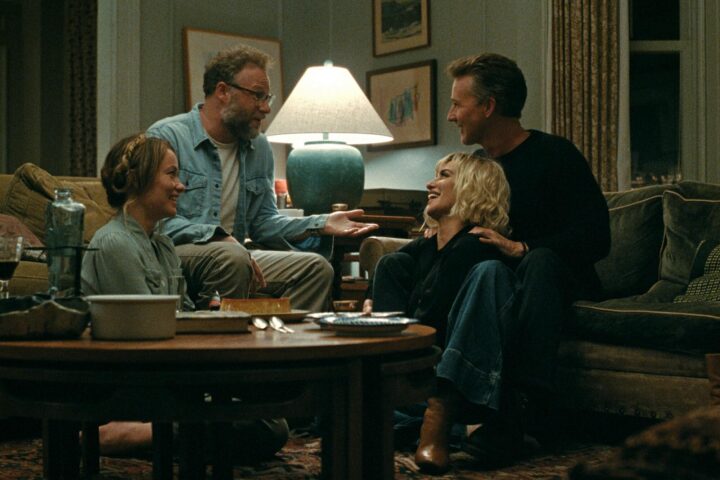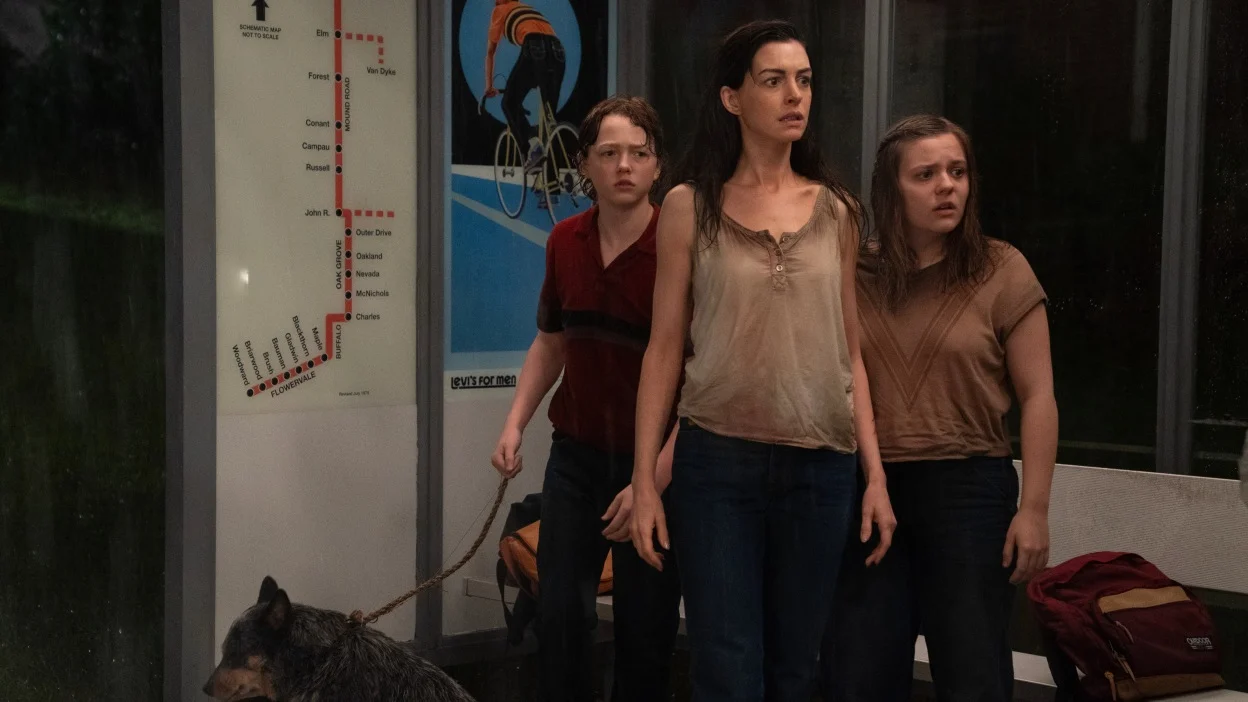
As a loving evocation of the early 1980s—or perhaps a nostalgic endearment for the era’s defining movies—David Robert Mitchell’s dino-thriller The End of Oak Street is a summer sleeper supreme, a nifty throwback so sharply crafted and performed that it may be the season’s most enjoyable big-screen experience. Taking a page—or three—from vintage Spielberg in its tale of a Midwest family whose cul-de-sac is beset by (what else?) prehistoric predators, Mitchell constructs a pitch-perfect period milieu before blowing it to hell in a frequently scary monster movie that somehow makes big-screen dinosaurs feel terrifying again. It’s the best film of its kind in decades.
The movie’s hook channels E.T. and Poltergeist in its master shot of a suburban enclave, home to Anne Hathaway and Ewan McGregor as an unhappily married Michigan couple whose love has seen better days. While Denise (Hathaway) secretly toils away on a typewritten manuscript about an unfulfilled wife, Greg (McGregor) delivers pizzas to make ends meet. In their split-level home, they parent teens Audrey (Maisy Stella, the terrific star of My Old Ass) and Brian (Christian Convery), and the efficient screenplay quickly establishes each as a likable human. It’s effective, economical storytelling—and it happens within the first ten minutes during a sun-dappled community block party.
And what an opening. That neighborhood street fest doesn’t merely dress up an era but effectively recaptures bygone, classic movie magic—the uncynical innocence of American teens tossing water balloons while dreaming of Carl Sagan’s Cosmos, snarky neighbors, a pretty new student, outracing neighborhood bullies down Main Street on old-school BMX bicycles and bonding with the loyal family pooch—while also hinting at deeper familial rifts. Denise and Greg are on edge (she’s on the verge of calling it quits), and their pained kids feel the strain.
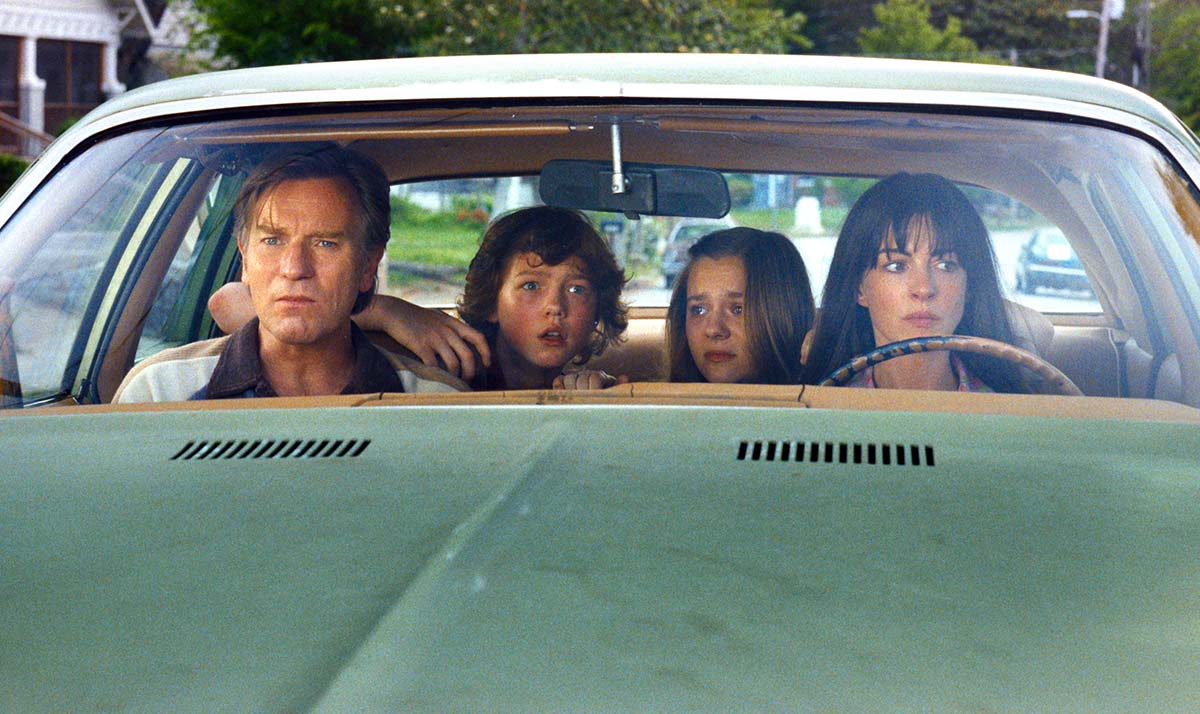
Nothing like a life-threatening crisis for family reunification! Strangeness is afoot—giant piles of dung and centuries-extinct plants emerge, followed by blinding flashes in the middle of the night. For reasons perhaps best left to Mitchell’s screenwriting, a wild contrivance tears a wormhole—stay with me—in time, hurtling the neighborhood backwards (I think) to the prehistoric era, where their Oak Street hamlet is suddenly, inescapably surrounded by swamps, volcanoes, tropical jungles—and many, many threatening dinosaurs.
Can Denise and Greg save their kids, their marriage and themselves? This is all great fun, firing on all cylinders and working like a charm. Terrific performances? Hathaway, especially, knocks this out of the park as the sidelined mom with a dream to reinvent herself, who comes into her own as a feral maternal protector; it’s a hoot seeing her furiously take on a T-Rex ferociously trying to tear her from her car, and then try to gobble her from a neighbor’s porch.
Super special effects? Indeed. Gone are the usual fakey CGI/AI, low-stakes creations of most fantasy films; ILM’s Jay Cooper led the technical wizardry, which is terrifically convincing, even scary. The effects team has outdone themselves sequence after sequence, including that marvelously limber T-Rex and a thrilling, quiet sequence involving a very long prehistoric worm surreptitiously infiltrating the family home, which builds to a brutally effective denouement.
Mitchell, creator of 2014’s cult horror hit It Follows and 2018’s dismissed Under the Silver Lake, makes all of this work in 99 trim minutes (90 would have likely been sufficient), never losing sight of the humans at the center of the sci-fi thrills. Both Hathaway and McGregor are touchingly vulnerable together and a well-matched pair of unlikely heroes showing up for their kids, even when Mitchell audaciously throws shocking surprises at them (and us). Somehow, he’s pulled off a summer movie with huge spectacle that keeps the family firmly in front of its creatures; we care deeply about them and their efforts to keep their family intact.
The picture’s technique is impeccably retro-appealing, with cinematographer Mike Gioulakis providing a period-authentic grainy sheen (shot on digital but looking every bit like 80s celluloid), while composer Michael Giacchino’s loving, melodically rich orchestral homage to John Williams has as much transporting power as the film’s space-time continuum (which gets pretty loopy in the final moments; better not to think too much and just go with it).
A treat.
3 1/2 stars