A year after its first teaser began selling out advance IMAX screenings, Christopher Nolan’s The Odyssey arrives as a staggering movie, so big-canvas and exciting, yet so humanly observed, that it recalls the long-lost Hollywood epic, where heroic adventures were told with both scope and purpose.
Nolan, who won picture and directing Oscars last time out for 2023’s Oppenheimer, keeps topping himself (his only real head-scratcher was 2020’s impenetrable sci-fi espionage thriller Tenet). And while only at 2026’s midpoint, it’s hard to imagine The Odyssey won’t repeat Oppenheimer’s Oscar coup.
Shot for a reported $270 million and entirely on 70mm IMAX (a format only 41 theaters around the world can faithfully project), The Odyssey finds Nolan swinging so big that the risk-reward nearly knocks you over with the sheer audacity of an artist’s singular vision, mounting big-screen-only wonders few other working contemporary filmmakers dare (or perhaps care) to attempt.
Those Homeric marvels include menacing beasts, sorceress witches, benevolent and vengeful gods, lethal sirens, lost souls roaming Hades, warcraft perils on land and sea, treacherous power plays and a gratifying family homecoming that ranks as Nolan’s most touching hour in a career of coolly cerebral works. In sequence after sequence, the architecturally visionary filmmaker stages set-pieces of immense ambition and craftsmanship. This is not to say that The Odyssey is mere populist escapism (Clash of the Titans it isn’t); it trades “fun” for smarts and rigor.
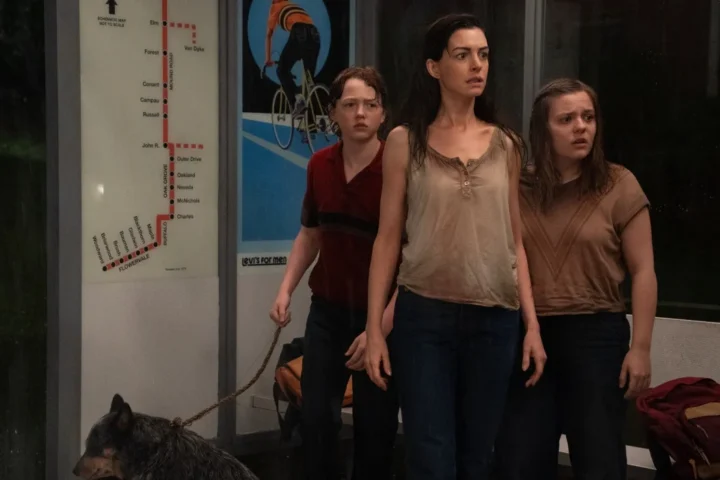
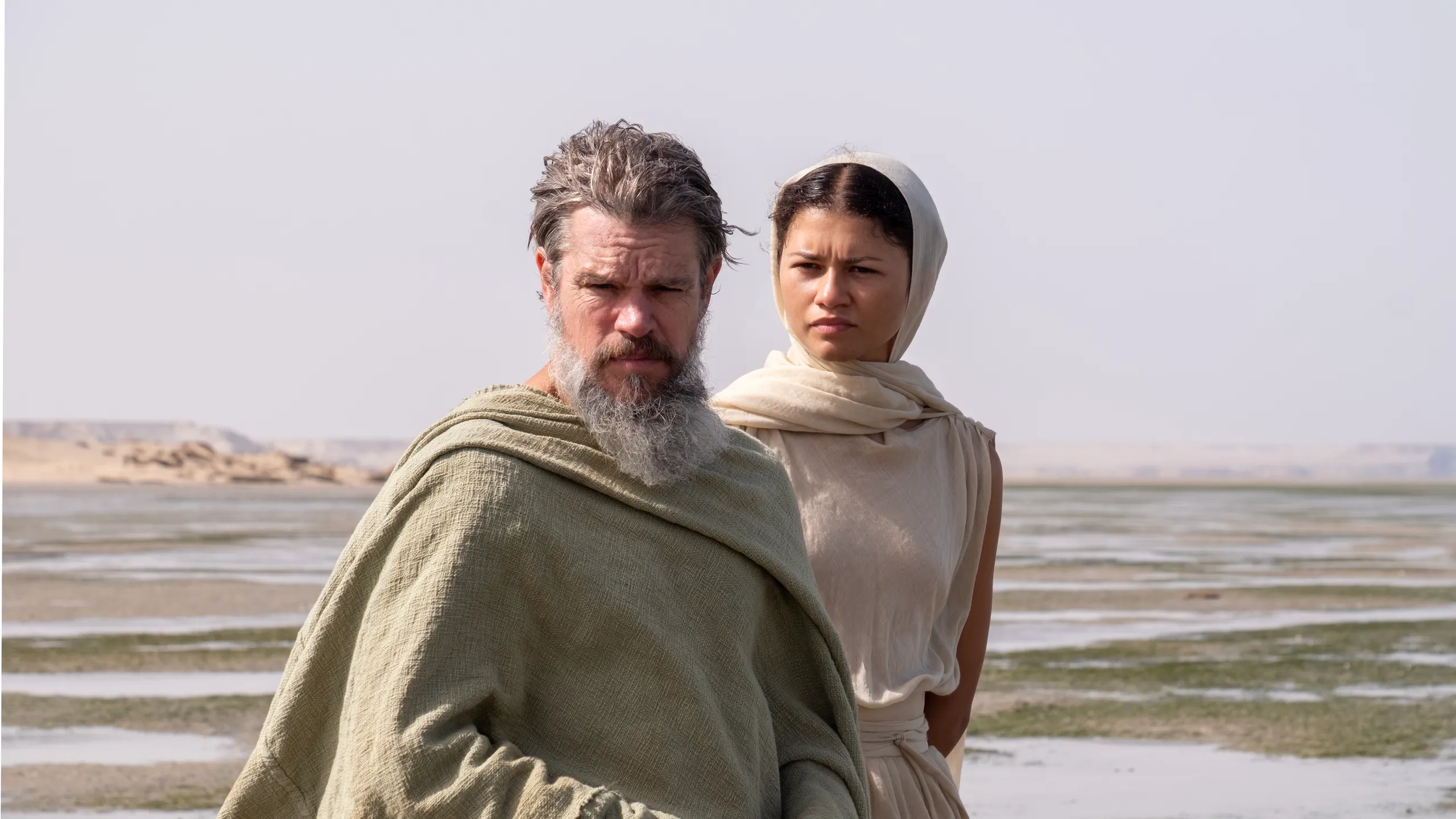
In a career performance, Matt Damon (full disclosure: I briefly wondered how Leonardo DiCaprio might have approached the role), is King Odysseus of Ithaca, away for two decades of the Trojan War and its aftermath. The picture opens on a knockout shot of the famed Trojan horse half-buried at the seaside, recalling the coup de grâce finale of 1968’s Planet of the Apes. Son Telemachus (Tom Holland), a boy when his now-presumed-dead father departed, has been forced into manhood, ready to embark on a quest to find dear “dad” (Nolan, who adapted the screenplay, indulges in modern vernacular). Meanwhile, Queen Penelope (Anne Hathaway, claws out) pines for her husband’s return, pressured to remarry or surrender the throne of the once-great kingdom.
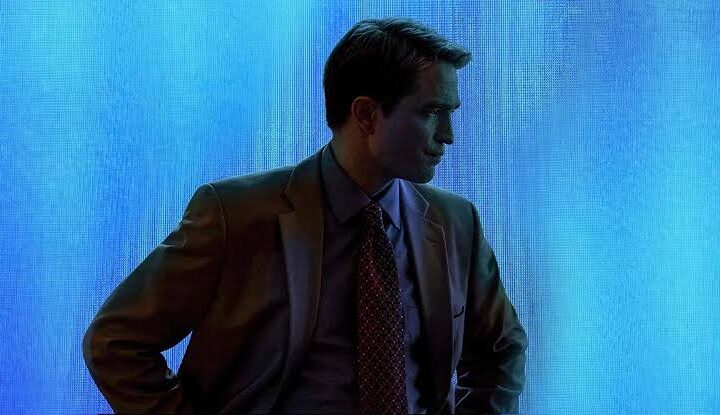
There’s a juicy secret plot in the midst, courtesy of power-hungry suitor Antinous, played by Robert Pattinson with venomous arrogance and an Ithaca-entitlement complex that won’t be denied; Mia Goth also turns up as Penelope’s (dis)loyal maid and Antinous’ co-conspirator. Waiting for his kingly friend’s return is Odysseus’s faithful, blind servant Eumaeus (a warm John Leguizamo, gamely distracting).
The movie shuttles between palace intrigue and Odysseus’ roving exploits of battle and myth, which, courtesy of Nolan’s go-to DP Hoyte van Hoytema, are awe-inspiring, beginning with an early sequence as the warriors do battle with the sheep-herding Cyclops (Bill Irwin), a killer giant with a hefty appetite (the most violent Nolan has ever been). The dialogue here about escape is slightly on the nose (and we’ve already thought of the solution before Damon articulates it to his men). Still, the creature, a hulking, one-eyed terror, is a real movie feat—a 60-foot animatronic puppet whose movement and voice came courtesy of Irwin, a literal towering achievement of practical effects and performance, sans CGI.
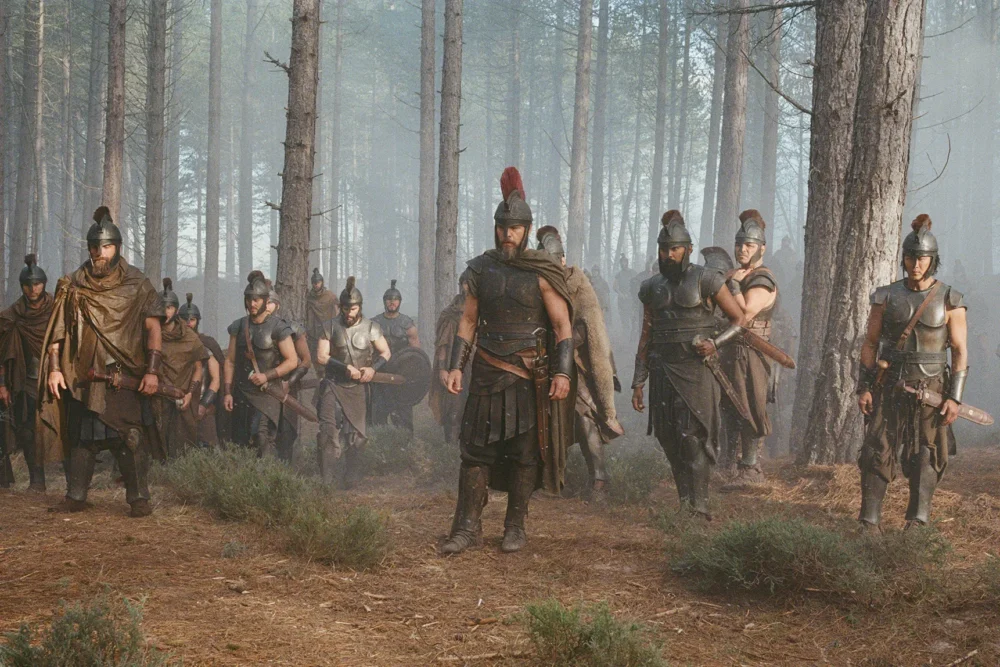
Another terrifically staged digression features a standout Samantha Morton as witch Circe, who transforms Odysseus’ men into pigs; still another conjures a giant sea whirlpool (Nolan and team created turbulence and swells and then digitally enhanced) that threatens to suck Odysseus’ ship into its spiral. And a creepy sequence involving sirens, calling the men to doom, is superbly staged on a ship deck, with novel sound design.
And there’s much more, including the Trojan horse ambush on Troy, deployed in two sequences; only in the climax does Nolan bring its thematic significance into focus. And Charlize Theron is nymph Calypso, who nurses a PTSD-stricken Odysseus, whom she loves, while conveniently making him forget his home—for ten long years.
Shot over 91 days in six countries including Greece, Morocco, Italy, Iceland, Scotland and the Western Sahara, using helicopters to access roadless, steep mountain locales upon which the production built massive sets (eschewing CGI and AI), The Odyssey looks and feels alive in a way movies are rarely made anymore. And unlike Hollywood’s many green-screened, CGI-infested adventure films (most of which are failing with moviegoers), every cent of Nolan’s budget is onscreen.
It’s not a perfect film—Holland, whose best work remains his prodigious adolescent turn in 2012’s tsunami survival picture The Impossible, is miscast, lacking in classical (and vocal) gravitas, while both Goth and Zendaya (as the goddess Athena) are underutilized. As for the film’s first hour, it can be challenging to follow Nolan’s time-hopping—his signature obsession—as he deploys multiple-perspective flashbacks with cursory context.
But there is no denying the visceral power of the movie’s final act, the rousing return of a pauper-king, dispatching betrayers in tactile combat, slinging arrows and spears after the desperate Penelope commands her suitors to an ill-fated rite of passage. Damon, 55, has lost none of his Jason Bourne verve while Hathaway is formidable in a searing mother-son exchange.
Nolan crafted the screenplay, heavily informed by Emily Wilson’s 2017 translation positing a morally complicated Odysseus; he strips away any heroism in favor of gritty perspectives on the trauma of war. Surprisingly, the movie’s take on warfare aligns with that of Oppenheimer. Just as Robert J. Oppenheimer struggled with intense guilt over the devastation wrought by atomic hellfire, Nolan fashions Odysseus as a man haunted by suppressed memories of the devastation he unleashed at Troy and the men he lost—and it’s here that the movie, for all its eye-popping craft and thrills, sticks the landing.
As Nolan sees it, Odysseus returns to Ithaca not in glory but instead burdened by what he did in the fog of war, a timely theme acted by Damon with emotional realism that is surprisingly effective in Homer’s ancient mythical context. Nolan has also largely excised the role of The Odyssey‘s gods from his retelling (save Athena, sort of Odysseus’ personal confidant, and threats of Poseidon’s wrath that hang over the soldiers’ fraught voyage).
The Odyssey has been a lightning rod for Elon Musk-led casting controversy surrounding supporting players Elliott Page and Lupita Nyong’o, who found themselves on the receiving end of a sordid, much ado about nothing wave of racist and anti-trans abuse online. Page, an Oscar nominee for Juno, and Nyong’o, an Oscar winner for 12 Years a Slave, play Greek warrior Sinon and twin sisters Helen of Troy/Clytemnestra, respectively. Though their appearances here are relatively minor, both deliver fine performances that make the most of their limited screen time. As the doomed warrior Sinon, Page has a knockout Hades-set scene taking Odysseus to task for his demise. As for Nyong’o’s striking Helen of Troy, she’s deemed—due to her scarring—as “the face that launched 500 ships,” a cruel barb from Spartan king Menelaus (a modern-sounding Jon Bernthal).
The Odyssey is an essential achievement that demands, and deserves, to be seen on the finest premium format screen possible. If you love movies—and you wouldn’t be reading this if you didn’t—make your pilgrimage to the biggest screen you can find.
4 stars