Sexiness is back in American movies after an era of intimacy-averse Hollywood that all but erased the freewheeling “sex comedy” from screens. The reasons for its extended hiatus are many—polling from turned-off young moviegoers, post-#MeToo intimacy coordination and A-lister anxieties about viral screen grabs. Consequently, ribald commercial comedies fell out of fashion; classics like Bob & Carol & Ted & Alice, Fast Times at Ridgemont High and Risky Business belong to far less encumbered eras.
But adult content is enjoying a revival in prestige pictures like the Oscar-winning Anora, Poor Things and Babygirl, while comedies such as Bottoms, No Hard Feelings and last year’s spouse-swap buddy picture Splitsville may signal a renewed appetite for racy laughs. Now comes Olivia Wilde’s savvy, altogether hilarious The Invite, a riot of marital unrest, temptation and the threat/thrill of polyamory, played so well by a smooth machine team of rarely better stars that it ranks among the year’s most enjoyable moviegoing experiences.
On her third time in the director’s chair, Wilde’s The Invite is an impressive feat of sustained, anxious lunacy—closer to two laughs a minute than one—and the idea of sex, as both a marriage killer and an alluring liberation, exerts a gravitational pull. Working from a devilishly sharp screenplay by Will McCormack and Rashida Jones, adapted from Spanish writer-director Cesc Gay’s 2020 The People Upstairs, Wilde—whose Booksmart delivered big laughs while Don’t Worry Darling brought bold style (and, ahem, a bit of Harry Styles controversy)—takes a major and assured step forward as a director.
A biting chamber piece largely set inside the sprawling San Francisco apartment of an unhappily married couple on the verge of realizing it, The Invite is anchored by career-topping performances from Wilde and Seth Rogen as longtime spouses about to face a reckoning.
The film opens on a petty squabble after acerbic former musician-turned-associate professor Joe (Rogen) learns that his high-strung wife Angela (Wilde) has invited the new couple upstairs for a little unwanted get-to-know-you. As the pair talk over and walk around each other with zinger disregard, Wilde establishes a comically worn marital dynamic. By the grace of Joe’s deceased parents they reside in a far more expensive home than they could otherwise afford, yet inside is a life of constant confrontation. For his part, depressed Joe has a bad back and lost himself as an artist, while Xanax-popping Angela, who studied art but never pursued a career, is stuck in the stay-at-home doldrums, obsessively home decorating to distraction.

Those upstairs neighbors arrive—do they ever—in the form of a game Penélope Cruz and Edward Norton as hilariously enlightened, libertine lovers as free as their hosts are bound. Psychotherapist and “sexologist” Pina, a blonde Venus vision in Cruz, is played with such non-conformist allure and sly comic predation that the actress delivers the best supporting performance in an American movie this year. And her rug-obsessed, former firefighter turned Rolf masseuse boyfriend Hawk (Norton) is part swinger, part life coach and so comfortable in the film’s escalating absurdity that he turns his hosts’ discomfort into some of the evening’s funniest moments.
If the dinner party goes quickly and superficially off the rails (a very funny Pina brings flan but rejects everything on Angela’s over-prepared menu, including the Spanish jamon), what follows is a pointed dissection of marital dynamics and fidelity over a painfully awkward, too-long night. For Joe and Angela, the stakes are high—they’ve got a 12-year-old daughter who seems to be their only real common ground—but if they’re already on thin ice with their frequently scorching recriminations (and a bit of mutual deception), Pina and Hawk push them into even shakier territory. The introduction of their enigmatic bohemian neighbors only underscores what they’ve lost and how desperate Angela is to recapture it.
Both couples have their own agendas, and there’s a funny bit of misdirection where Angela apologizes for renovation commotion while the Joe’s real aim is to get to the bottom of what’s happening upstairs in the middle of the night—a major source of noise—which Pina and Hawk are more than willing to explain away, to uproarious comic effect.
This sequence, as Wilde performatively hangs on Cruz’s deadpan details of swinger etiquette (“There’s a menu?”), her Angela determined to join the cool kids club, is among the star’s finest and movie’s zaniest; she’s never been this loose onscreen, and her spirited line deliveries (“Don’t be rude, look at her boobs!”) land with deadly funny precision.
The desperation Wilde is playing here—Angela suffocating in her staid marriage while trying to reclaim an adventurous spark, however vicariously—has real punch. Special mention goes to Cruz, who’s been vital and sexy and intelligent onscreen for about 35 years, here reinventing herself with a confident comic command that tilts the movie (and us) toward her every time she’s in frame. And while Rogen could perform this material eyes closed by simply trading on his patented sardonic irreverence, here he points those trademarks toward some poignant truths.
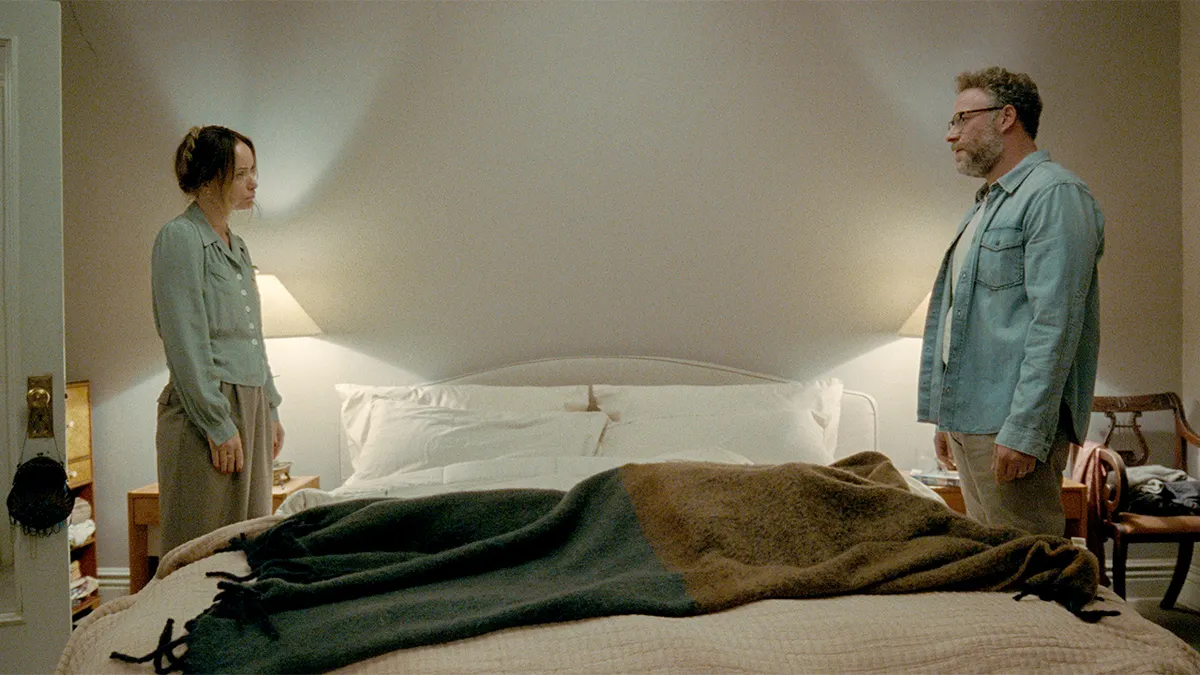
Throughout, he’s used to maximum effect as straight man to the escalating hijinks; his reactions in a scene where he and Cruz steal away and propose coupling up is fall-down funny, as is an awkward kitchen tryst between Wilde and Norton, both couples spiraling toward something deeper that will cut to the core of long-term commitment.
In scenes like this, as the acting quartet takes off, you start to notice how carefully the comedy is built into the characters, and how Wilde’s camera catches it all in side glances, asides and pained reactions; each actor is clearly having so much fun that anywhere the camera looks, something special is happening. Wilde ingeniously carves out this comedic psychodrama in tight close-ups. Yet somehow, her movie never feels stage-bound; the apartment is an integral character, as if in on the fast-clip jokes, frequently and effectively underlined by composer Devonté Hynes’ high-stress cello.
The Invite has a nervy, near-farcical acceleration that’s a blast to plug into, but the hilarity comes out of something painful underneath; the film’s swerve toward third-act Who’s Afraid of Virginia Woolf? truth-telling can feel slightly abrupt (though no less lacerating); consider that a minor non-quibble. It’s hard to believe that anyone in a long-term relationship won’t feel a shock of recognition, especially after a riveting exchange about how in order to continue on, together, you must sometimes accept that things, at least as they were, are over. This is exceptionally fine writing and a reminder of how good American comedies used to be when grown-ups talked honestly about such topics as sex, marriage and the big “existential” questions (there’s a funny joke here about that too).
At times, The Invite recalls vintage Woody Allen in its stinging one-liners and mordant observations on relationships, love and the human condition. I laughed to tears—an uncommon thing in American comedy today—and found myself unexpectedly moved by the end.
Highly recommended.
4 stars