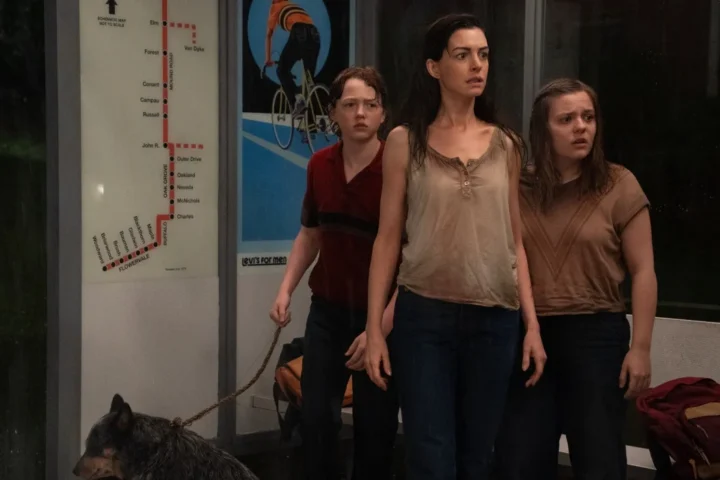
I knew Carolina Caroline had left its mark when I couldn’t stop thinking about its title character after my first viewing. On the second screening, I plugged into the rhythms of its central relationship and almost melancholic country-and-western lyricism, and the way star Samara Weaving’s performance—as a Texas girl who goes on the run with Kyle Gallner’s worldly drifter for a wild crime spree—deepened from scene to scene. By the third, I knew director Adam Carter Rehmeier made everything work because, like us, he felt for the people at its center.
At face value, Carolina Caroline nods to a long line of outlaw lovers on the American road that perhaps began with Arthur Penn’s 1967 classic Bonnie and Clyde, where lovers pull off cons with abandon, tearing across the landscape in muscle cars, carousing in roadside motels and working us over with the vicarious thrill of the take. But Rehmeier’s gives his film a surprising tenderness; we come to care for two likable young people searching for a bigger hand than they’ve been dealt. The power of Carolina Caroline comes not from the lovers’ criminal exploits but from the doomed romance that develops along the way.
I recently caught up with the director to chat about Weaving’s remarkable performance and the film’s challenging production schedule, which spanned nearly 100 locations in just 25 days across rural Kentucky. We discussed our shared nostalgia for fading Americana and ’70s crime road movies, and he offered insights into how his top-notch production team mounted Carolina Caroline, finding fresh territory within a familiar genre to deliver one of the year’s most affecting independent films.
ChicagoFilm: I’ve seen the movie three times now, and I’ve fallen in love with it. When you see enough movies, sometimes you fall in love with characters, too. It happens to me a couple of times a year. I’ll walk out of a movie and think about a character until I see the movie again, and then even afterward. Samara Weaving—I think I’ve seen everything she’s ever done, and I’ve always liked her—but something about her characterization here really affected me.
Adam Carter Rehmeier: Yeah, that’s what I’m going for. I’m always trying to create memorable characters. When I first got the script, it was very different from the finished film. Tom Dean’s script had the bones of what I thought could become a ’70s road movie, but it wasn’t there yet. At that point, it played more like a crime thriller. In fact—and this is a spoiler—the original ending had what I’d call a B-movie twist. Oliver turned against Caroline and tried to kill her, and she ended up having to kill him.
I told Trevor and Tim White, from Star Thrower, who had optioned the script and brought it to me, that I saw the movie as a love story. I pointed to the scene near the beginning of the movie where they go to the rock quarry. They’re bobbing in the water together, and she asks him, ‘What do you do?’ He says, ‘You know what I do.’ Then she asks, ‘What do you do if you get caught?’ He says, ‘I don’t get caught.’ And she replies, ‘I caught you.’ I said, ‘This is a ’70s movie.’ It’s behaving that way in this part of the script, and I really liked that. If the rest of the film could feel like that, I would be all in.
So we talked to Tom. I gave my notes, and Tom incorporated them into the script. It wasn’t quite there yet, though. We started working with an actor. I had cast Samara, and we had cast another actor instead of Kyle. I’m not going to say who it was or go down that path. But we started working with that actor and tailoring the script. In the original version, Oliver was described almost like a Kennedy. He wore a Rolex, dressed in fancy suits and drove a Mercedes.
CF: By the way, is it a Chevelle?
ACM: Yeah, it’s a Chevelle.
CF: My dad had a yellow one. That was our first car.
ACM: The yellow Chevelle?
CF: Yeah. A ’70s model.
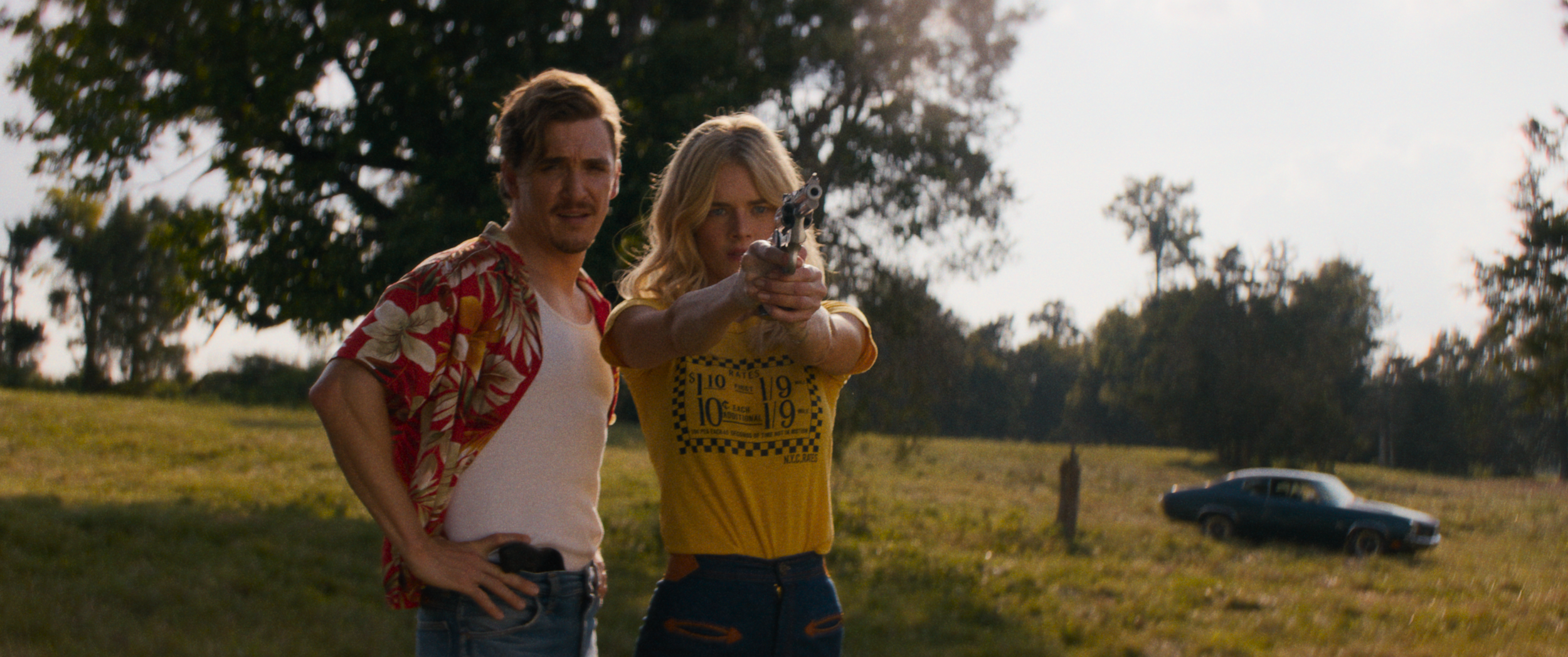
ACM: So that version of the character didn’t appeal to me. I thought he should feel American. He should drive an American car. I wanted him to have a sort of neo-cowboy quality. That’s where the drifter aspect came from—the Canadian tuxedo, denim from top to bottom, kind of a Martin Sheen in Badlands vibe. My thought process was simple: hot guy, hot girl, a gun and a muscle car. Those are classic ingredients. Dirty Mary, Crazy Larry was a big influence.
CF: My childhood favorite.
ACM: Thunderbolt and Lightfoot was a huge reference for me. The Great Texas Dynamite Chase was another one, although a smaller influence.
CF: I never got over that final scene in Dirty Mary, Crazy Larry. Ever since I first saw it as a kid.
ACM: Yes! Or Vanishing Point—another great ’70s film. Those movies behaved differently. They were more abstract, and that’s what I wanted this film to vaguely feel like in my own modern way. Originally, Tom’s script was set in the early ’90s. I had just finished Snack Shack, and I knew we were making this film on a budget. We had 25 days and almost 100 locations. It’s almost an impossible ask.
CF: That must have been a low shooting ratio.
ACM: Yeah. It’s just hard to do with all the company moves; constant company moves. It was like guerrilla warfare filmmaking. We moved the timeline forward, but I didn’t want to move it too far. Post-9/11, with CCTV cameras and everything else, it became exponentially harder to rob banks. I don’t know the exact statistics, but I’d bet bank robberies dropped dramatically compared to the 1970s. So I thought: let’s set it in a period that reflects how we looked back at ’70s movies during the ’90s. I’m an ’80s and ’90s kid. We romanticized those films from the ’70s. Let’s do the same thing here. Let’s set it in the early 2000s but have it play like a ’70s movie. That way, people who are 30 or 40 today can look back at it and think, ‘It’s retro. It’s cool. It’s turn-of-the-century.’
With Snack Shack, I was looking at movies like Stand by Me and thinking about how cool the cars were, the guys in white T-shirts with cigarettes rolled into the sleeves and everybody listening to bubblegum rock. That’s a great movie because, at the end, you discover Richard Dreyfuss is the narrator. He has kids of his own, and he’s been reflecting on a story from about 30 years earlier. That’s the sweet spot for nostalgia—25 to 30 years. And that’s where Carolina Caroline sits today. It’s about the distance between where we are now and where we were 25 years ago. That’s how I thought about the setting.
CF: I have this love of Route 66 and fading Americana. I miss many things—single screen movie houses we used to have that were torn down, diners, drive-ins. I still go to the drive-in that I grew up with, the Getty-4 Drive-In in Muskegon, Michigan. It’s still standing and people still go. This movie has a feeling of vanishing Americana to it. It’s a texture. As you’re taking this road trip with the characters, you’re also taking a trip through that world.
ACR: Here we are in the birthplace of Route 66, right here in Chicago; Chicago to Santa Monica. I was fortunate enough in the ’90s, when I moved from Chicago to Los Angeles, to make that drive many times. My parents lived in Nebraska, so I was constantly going back and forth. I watched a lot of it disappear. I always took the road less traveled. I’d take Route 66 or some variation of it—the dusty roads, the two-lane blacktops. I watched everything move out toward the highways. The great thing about Route 66 was that it went through the center of all those little towns. Then you’d see the mom-and-pop businesses start boarding up and disappearing. That imagery stayed with me.
Luckily, we shot in rural Kentucky, and a lot of those places were still thriving. They didn’t have major highways running through them, so we were able to tap into that and capture a lot of it. It was basically free production design. Many of those places had been left relatively untouched. We cheated a lot of states. We cheated Texas, Georgia, Arkansas, Florida and South Carolina. We were constantly making one place look like somewhere else. And we did not (do the post production) up in Louisville and shoot within a 25-mile radius. We shot in Shelbyville, Shepherdsville, New Haven, Bedford, Frankfort and Bardstown. We were all over the state.
It was not an easy shoot. We were extremely mobile, constantly grabbing little pieces of things and stitching them together. Honestly, out of every production I’ve done—and I just wrapped a movie in South Africa where I had 41 days instead of 25—this was without a doubt the hardest shoot I’ve ever done. I was waking up with panic attacks over locations dropping out.
One of the biggest challenges was dealing with bank owners. For better or worse, some of them were worried about copycat bank robberies! In the history of cinema and the history of bank robberies, I don’t think there’s much correlation there, but you can’t laugh at those concerns. You’re trying to win people over, and sometimes you just can’t. We had a really hard time getting permission to shoot inside banks. I think they were called Stock Yards Banks. The blue bank in the montage—the one where Caroline is wearing the red, white and blue outfits—that was a Stock Yards Bank. I believe the first bank she robbed was also a Stock Yards branch. We renamed it Herkimer Bank. Frankie (Francesca Palombo), my production designer, came up with that weird name because it would clear legally.
I really do have the best team in the world. I love the men and women I work with.
-Adam Carter Rehmeier
But they had a branch in Indiana that was willing to work with us, so we had to drive about 75 miles from Louisville. We drove all the way up there, shot during the day, then came back and shot a night scene. A day like that is brutal. You start by driving 75 miles one way, shoot through lunch, drive 75 miles back, and then shoot an entire night sequence. That’s a ‘Fraturday’-type day.
CF: One of the things I love about this genre—if you want to call it that—going all the way back a half-century to Bonnie and Clyde, is that the first half of the picture is usually where we fall in love with the couple. We want to see them together, in bed, on the run, pulling off crimes. It’s exciting. In this movie, there’s real chemistry between them. That’s a hook right from the beginning. I think we fall in love with them the way they’ve fallen in love with each other. Then the second half, where the law inevitably catches up, is never welcome. I was surprised by how invested I became in Caroline and Oliver. I almost felt like you were more interested in the love story than the robberies themselves. Am I wrong about that?
ACM: No. It was always a love story. The bank robberies, the cons, all of that was secondary. This is going to sound abstract, but I remember seeing Tony Scott’s Man on Fire—the Denzel Washington version, not the original. What always stuck with me was that they spent almost an hour building the relationship between Denzel and Dakota Fanning before anything happened. You became invested in them. Their relationship had an arc. It evolved. So when she gets kidnapped, the back half of the movie works because you’ve already spent that time with them. I was conscious of that when redesigning this script. I thought a lot about how much time we spend with Caroline and Oliver before anything major happens. Obviously, they’re very different movies, but I admired how Man on Fire developed its characters before putting them into the central conflict. I was definitely thinking about that.
CF: Caroline is a small-town girl who wants to see the world, and the cons and robberies become a way for her to escape and experience something larger. Yet what I found so compelling about her is that she’s also deeply introspective. Two moments really stand out. In the first, she’s in bed with Oliver, and says she’s afraid of getting close to people because she might actually be like her long-lost mother. Then later, she has that terrific line about whether they’re good people doing bad things, or bad people doing good things. I appreciated her search for her identity.
ACM: Those are Tom’s lines. Tom wrote those good lines! That’s part of what I loved about his script.
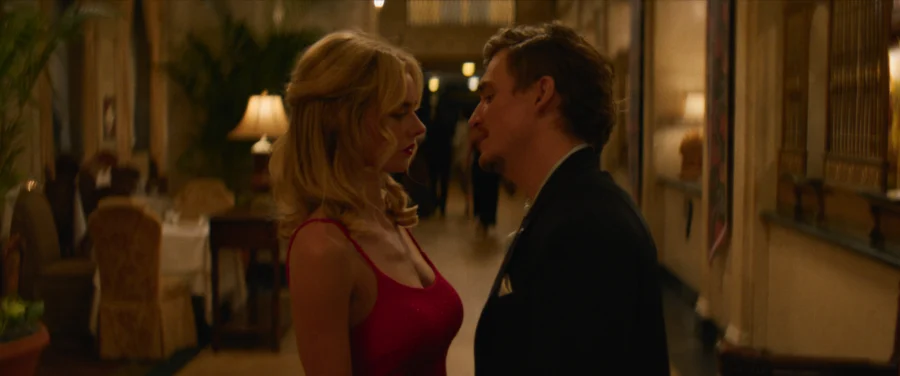
CF: The movie really works us over emotionally. When you reprise the Jason Isbell (Cover Me Up) song near the end, we realize how far we’ve gone with these two characters. That scene on the dance floor is heartbreaking. There’s a television screen over the bar with their photos while they’re dancing together, and the walls are closing in. That scene broke my heart.
ACM: That’s an interesting scene because, from a design standpoint, Jean-Philippe Bernier, my DP, and I designed it very specifically. One (earlier) dance scene moves clockwise, and the other moves counterclockwise. They’re mirrored scenes. That wasn’t in the original script. What also wasn’t in the original script was the song Carolina Caroline. The movie was already called Carolina Caroline, and I suggested we commission a version of the song. The original Jonathan Edwards song is good. We actually tried it in the movie, but it didn’t quite fit the tone. When we shot the dance scene, they were dancing to that song because we were still exploring different options.
We commissioned two artists. Courtney Marie Andrews did one version, and River Shook handled the version performed by the band at the end of the movie. River’s band actually appears in the film. My idea was that we’d hear the song one way when the relationship is beginning, and then hear it again at the end after everything they’ve been through. I wanted to see how the audience would feel about it after that whole journey.
The reality is that the Jason Isbell song started as temp music. Sometimes that’s dangerous because people fall in love with the temp track, but that’s exactly what happened here. It pulled so much emotion out of the material that I couldn’t imagine the movie without it once we locked the cut. At first, it wasn’t really on the table because it was an expensive song. Later, though, the producers were willing to revisit it because they missed it, too. They felt the emotional impact it brought to those scenes.
CF: It leaves you in tears.
ACM: Yeah. It does.
CF: And Townes Van Zandt’s Tecumseh Valley works the same way near the end as Caroline makes a certain phone call. The song carries through that sequence, and it’s affecting. Also, Chris Stapleton’s Parachute—everything works; Margo Cilker’s That River.
ACM: Justin Krohn, my editor, really curated that soundtrack. Usually, I have a lot more input. I’m sitting in the editing bay every day and I’m often suggesting tracks. But Justin would bring me two or three options at a time, and he just kept hitting home runs. Every song fit. I didn’t want to interrupt that flow because he was making such great choices. The soundtrack became one of my favorite aspects of the movie. You have things like the Nebraska cover and other tracks that just fit perfectly. There are so many great selections in there. Tennessee Bird Walk is a weird one in that first montage. I’d never heard it before. It’s a strange song, but it’s great. It adds so much playfulness.
There are twenty-four songs on the soundtrack. Like any good road movie, all of those songs are balanced against Chris Baer’s score. Chris created this pulsing, electronic, synthesizer-driven sound underneath everything. What I love is that neither the score nor the soundtrack draws attention to itself. It’s not flashy. It’s not trying to tell the audience what to feel. I think it’s all very thoughtfully curated and very well scored.
It was always a love story. The bank robberies, the cons, all of that was secondary.
-Adam Carter Rehmeier
CF: Samara’s performance in the scene where the police officer gets shot is perhaps my favorite. She has this sort of breakdown—or whatever the right word is. Her emotionality and physicality are so nuanced. It’s a complex, almost wordless piece of acting.
ACM: I can tell you exactly how we approached that scene. Jean-Philippe and I planned everything leading up to it. We knew we wanted to shoot it handheld, but in a very controlled way; almost like a human tripod. The camera is extremely steady at first. Then, once the officer gets shot, we stopped blocking things. We deliberately chose not to choreograph what happened next. We wanted it to surprise us. We wanted the actors to figure out the movement themselves. So when everything changes after the shooting, that’s all Samara and Kyle. Jean-Philippe is reacting in real time, trying to find moments as they happen. You’ll notice Samara drifting in and out of focus. Her eyes move in and out of focus because he’s chasing the performance rather than dictating it.
CF: She sort of turns sideways, back and forth, unstable. It’s quite a moment.
ACM: Honestly, it’s one of my favorite scenes in the movie. Production fought me hard on that location. I was absolutely committed to it because of the limestone walls and the way the sunlight dappled through the trees. There was something beautiful about that stretch of road. The problem was that it was incredibly difficult to control. We had to block off huge sections of roadway—something like a quarter-mile in one direction and half a mile in the other—so you wouldn’t see any traffic. Before we rolled the cameras, there were cones stretching forever down the road.
CF: That’s an extra layer of suspense in the scene. As viewers, we’re already worried about the drama playing out, and we’re also thinking somebody could drive by at any moment.
ACM: Another thing I love in that scene is when they speed away afterward. Kyle is really driving. There’s no process trailer. No tricks. At one point he starts pounding the steering wheel. That sound you hear is the actual sound of the steering wheel and steering column in that old Chevelle. It made the most beautiful noise. I remember our sound designer, Ugo (Derouard), replacing it with something cleaner. I told him, ‘No. Go back and pull it from the guide track.’ He said it was a little over-modulated. I said, ‘I don’t care. I love it.’ It’s probably my favorite sound in the entire movie. I didn’t care if it was technically imperfect because it captured exactly what that moment felt like. It’s the sound of a man who knows everything is over.
CF: And we haven’t seen him like that before.
ACM: Exactly. I remember saying, ‘Let’s pull everything else down around it. Let Caroline’s hyperventilating sit underneath it. Let the steering wheel speak.’ It all worked out in the end, but that sound was incredibly important to me.
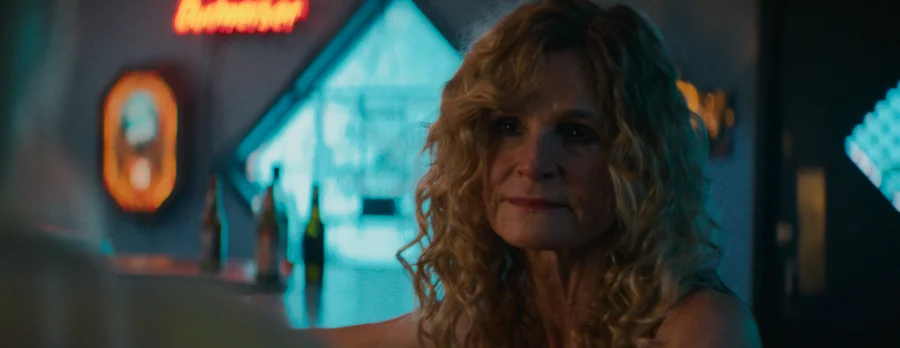
CF: Let’s talk about Kyra Sedgwick. She comes into the movie for a single scene and absolutely tears through the screen. It’s a ferocious performance. And what’s amazing is that she isn’t really ‘doing’ anything. She’s sitting the entire time. There’s almost no blocking.
ACM: Did I luck out or what? She’s incredible. You’re right. She comes in, sits down next to her daughter, and the whole scene unfolds. There’s almost no physical action. She smokes a couple of cigarettes. She has a couple of drinks. That’s about it. They’re not running around. They’re not chopping wood. They’re not doing anything. It’s just actors, in the best possible way. There’s no sentimentality there at all. If anyone expects a warm reconciliation scene, they’re in for a surprise.
I loved working with Kyra. I’d love to do something else with her because she absolutely blew me away. We had her for two days. One thing I told her beforehand was that I wasn’t going to break the scene up unnecessarily. It’s about twelve pages long, which looks terrifying on a call sheet. But because it’s all in one location and mostly one conversation, we could approach it almost like theater. I told her, ‘Let’s treat it like a one-act play.’ That seemed to make her feel a lot better. We shot all of Kyra’s coverage in one day and all of Samara’s coverage in another day. Then we spent part of the next day picking up supporting coverage—Greg, who plays Johnny, the guy with the pool cue, P.J. the bartender and some other material around the bar. After that, we shot (Samara) leaving the bar. I think we’d already shot her arrival at the house because we needed time inside the location beforehand.
It was brutally hot. Over one hundred degrees in Kentucky. And that location was deep in the hood. It wasn’t a safe area. I remember leaving one day and seeing a guy driving down the street trying to hit people with his car. I called our AD and said, ‘You’ve got to get everybody off the street.’ The guy doubled back and came right toward our set. And he pulled everybody out of the way, and sure enough, the guy drove right through the middle of our production trucks. It was crazy.
CF: There’s a shot late in the film that I love. It’s a drone shot where the car crosses railroad tracks. The car is moving in one direction in the frame while the camera is moving in the opposite direction along the tracks. There’s something unexpected about it.
ACM: My friend Richie Trimble handled all of the second-unit photography with Josh Quiros, our gimbal operator. What was cool was that the camera was mounted on a gimbal attached to the drone. Josh controlled the camera while Richie controlled the drone. Because they’re operating independently, you can create these really dynamic movements. It’s almost a true 360-degree system. I love those guys. We had one day allocated for everything you see in the movie. It rained, which gave us an extra half day. Every aerial shot, every driving shot, every montage sequence—day, night, rain, shine—they captured all of it in a day and a half. It’s unreal. The bridge shot that opens one of the montages—all of that was done in that same time period. I really do have the best team in the world. I love the men and women I work with. They’re fantastic.
This interview has been edited for length and clarity.