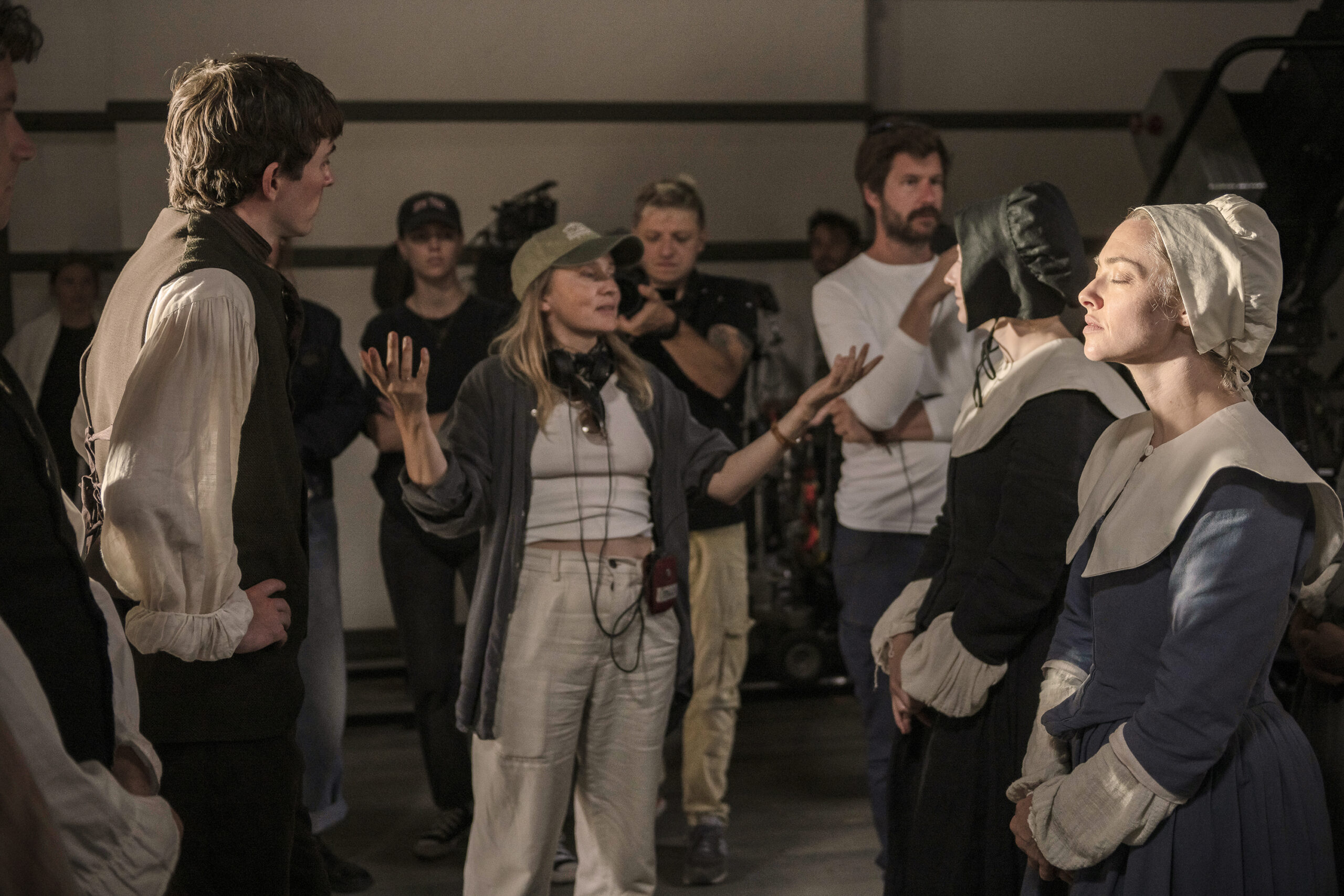
Filmmaker Mona Fastvold’s unconventional The Testament of Ann Lee is a striking origin story of the Shaker religious movement, its titular founder played by Amanda Seyfried in an enigmatic portrait of emotional, physical and spiritual conviction. Set in the mid-1700s, Fastvold’s epic charts the religion’s fledgling roots in Manchester to the rise of its New England colonies, using music and movement at the intersection of vision and faith. The result is both historically satisfying and unusually offbeat.
Watching the film, I was reminded of a pair of legends: Ken Russell, specifically for the visually charged, audacious near-absurdity of his historical outings; and Stanley Kubrick, in Fastvold’s meticulously composed tableaus, which pulse with gyrating bodies and hymnal rituals. Like the Oscar-winning The Brutalist, which Fastvold co-wrote and produced with partner and director Brady Corbet, The Testament of Ann Lee is also a Budapest-shot epic made on a similarly modest $10 million budget, allowing for autonomy in mounting a most rigorous vision.
I recently caught up with Fastvold in Chicago where she was candid on the challenges of crafting her uncompromising film, and how working independently comes with both freedoms and risks.
ChicagoFilm: I felt almost hypnotized by The Testament of Ann Lee; like I was in a dream.
Mona Fastvold: Oh, thank you. That’s the best. That’s what movies should be like.
CF: Ann Lee was a person I did not know about at all. Why this movie for you?
MF: Yeah. I just thought that she was about to become erased from history, because no one really knows of her. We know of the Shaker chairs; the design, the staircases. We know that this was a foundation in American aesthetics in a way—traditional American aesthetics really comes from the Shakers. And I thought the Shakers and the Quakers were the same thing. I didn’t know the difference. I just knew about it from a design perspective. I stumbled upon them while doing research on The World to Come and just thought the story was fascinating. This woman’s journey is incredible. How did I not know of this? I thought maybe it was just something you learn in school in America. And then I realized that no one knows about her, and maybe her story is thought to be really niche. But they had over 6,000 followers at the height of it. They had settlements all over America. It was massive. So there was this community with complete equality between gender and race in the late 1700s, led by a woman; a female religious leader. And I thought it was incredible. I really needed this story. I needed to understand it and to remember that it had existed and that we do stand on her shoulders as well. So I thought this story was one of what was possible.
CF: As a writer, what does speculative fiction mean to you? Or speculative storytelling? This film has elements of that approach.
MF: It’s an interpretation. When you’re writing a biography or autobiography, do you actually remember what you ate for breakfast or what you talked about with your parents when you were five years old? You take liberties and you imagine things. So it’s based on a ton of research. And then in the end, it’s also my interpretation. It is the story that I wanted to tell, inspired by her story, or what the story means to me right now. That is what this is.
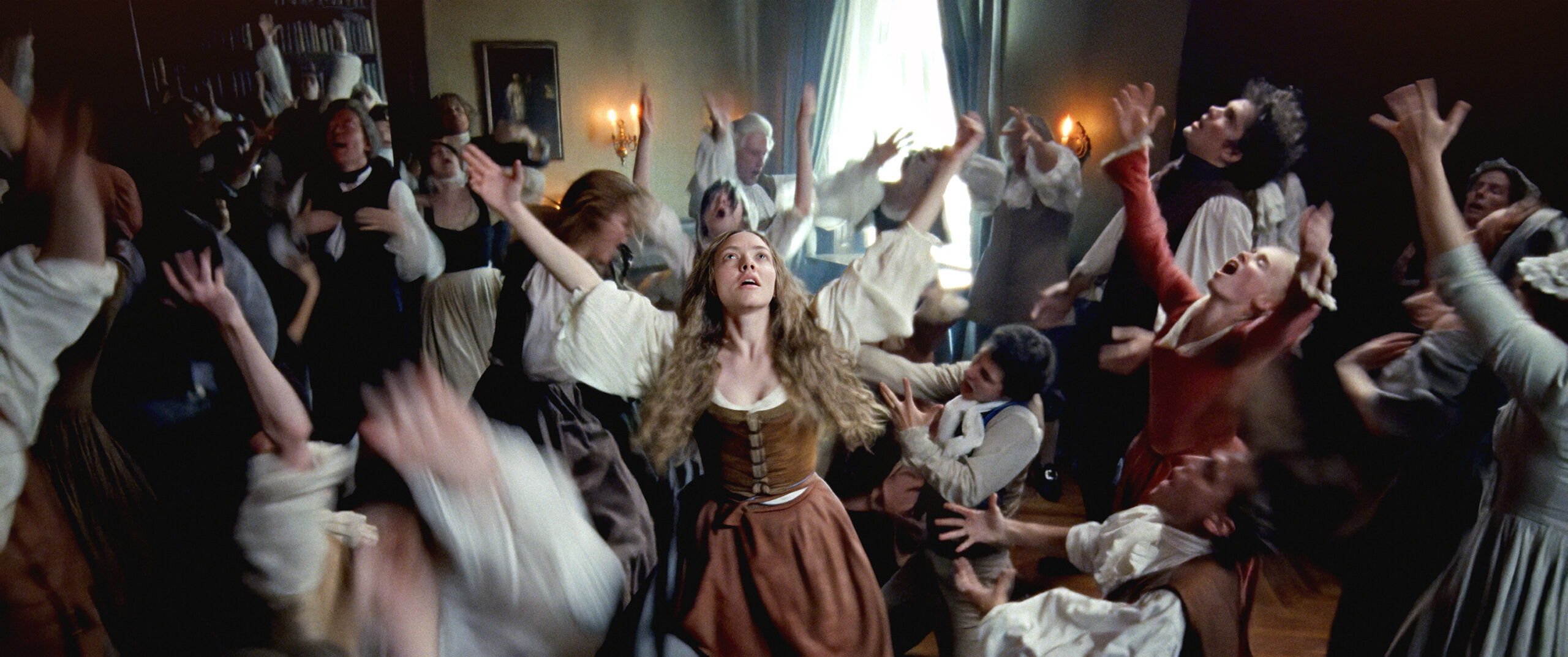
CF: Let’s talk about Amanda Seyfried. I met her once years ago, and I recall her as very petite and quiet; doll-like. And then, as I began to see her in many more films, I realized she could almost play anything—whether it was romantic comedy, a road Hollywood took her down, or sensual intrigue thrillers like Atom Egoyan’s Chloe or the new The Housemaid, or musicals like Les Misérables or Mamma Mia. And now we’re seeing her anew again. She made Ann Lee’s personal life—the marriage with Christopher Abbott and the early losses of the children, and how those almost propel her into this other place, mysterious and compelling. I was trying to figure her out right until the final frame, which I thought was a real strength. Often, religious figures are presented as archetypes: this is good, this is bad. With Ann Lee, you could call her evangelical or fundamentalist, but Amanda makes her a sort of utopian visionary. There’s that scene where Ann Lee is shocked to see enslaved people on the streets of New York. Amanda plays all of that beautifully. Why was she right for you for this role?
MF: It was all of that. She can do anything, really. She’s incredibly brave as a performer. And we had a very strong connection before the film, and we trust each other. There’s a lot of trust there. This was a scary role to play. This role was a trust fall into my arms that could have gone terribly wrong. So that intimacy and trust were a big part of it. But I also really saw her as this character. I had seen her strength. She said to me, ‘Do you see me as a leader? I don’t really see myself as a leader.’ And I said, ‘You are a leader. You’re number one on the call sheet all the time. You’re the leader of the small community we’re creating on a film set. You set the tone for what that should be in a very specific way. You’re kind and generous. You create. You’re a nurturing leader. You lead in a mothering way. And I see that. And that’s how I see Mother Ann Lee. That’s how she was a leader, too. She was a nurturing, mothering leader most of the time.’
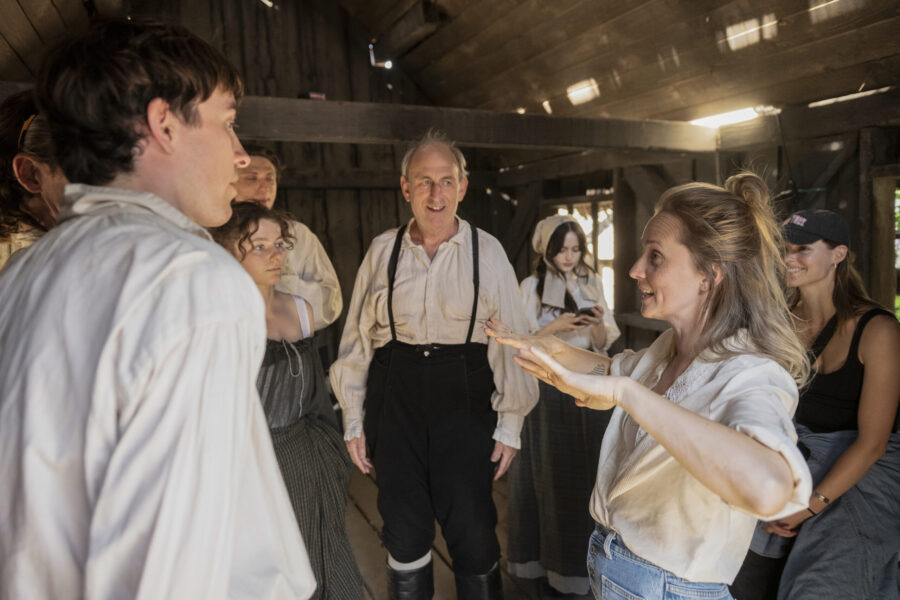
CF: I also loved the music and performative physicality. I was trying to memorize lyrics as I was hearing them during the film because they were so beautiful. Especially one sequence with Lewis Pullman, when he returns from prospecting settlements. A lot of them come out of worship, so it feels organic to the scene. And even though it’s technically a musical and neither the songs nor sequences follow musical convention, I never felt like I had to suspend disbelief.
MF: The Shakers worshipped through ecstatic song and dance. They would receive gift songs. They would feel compelled by the spirit, and the song would emerge from their body. You could explain it as folk songs passed down, or you could say this is a spiritual moment. For me, it had to contain movement and song because that’s how they worshipped. But it couldn’t be showy. It’s not for an audience. It’s not a performance. It comes from within. Every movement has meaning. It’s like shedding skin, putting on light, expelling suffering or sin, transforming it through movement and sound. That was really important to us in creating the soundtrack. It couldn’t be people just waking up and singing. I didn’t want a traditional musical. It had to be grounded in their religion and spirituality. The Shakers left behind almost a thousand hymns. Some songs in the film are original, while some are original Shaker hymns we found through archives and research that spoke to us. Some were written right after Ann passed away, and some later. We played them, sang them and they found their way into the film as the right expression of faith for each moment.
CF: The choreography is so uniquely original. That final overhead shot with the opposing formations—I was entranced by it. I had never seen choreography like this before.
MF: Thank you!
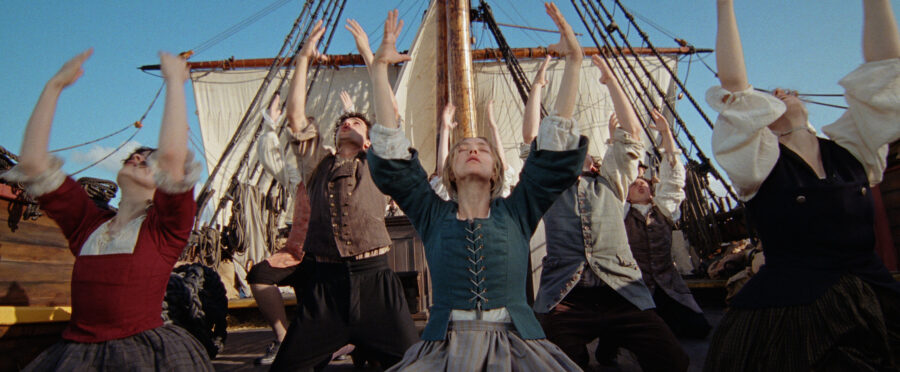
CF: There’s some gorgeous widescreen cinematography here and distinct visual styles. Visually, the Manchester section feels dark and heavy; it’s fascinating to look at those inky blacks and the faces within them. And when Ann Lee departs for America on the ship, which I understand was an actual ship you were able to shoot on, the film opens up visually in America.
MF: Yeah, we switched the film stock as well. Finer grain, lighter.
CF: What was the thinking about switching the look at that midpoint?
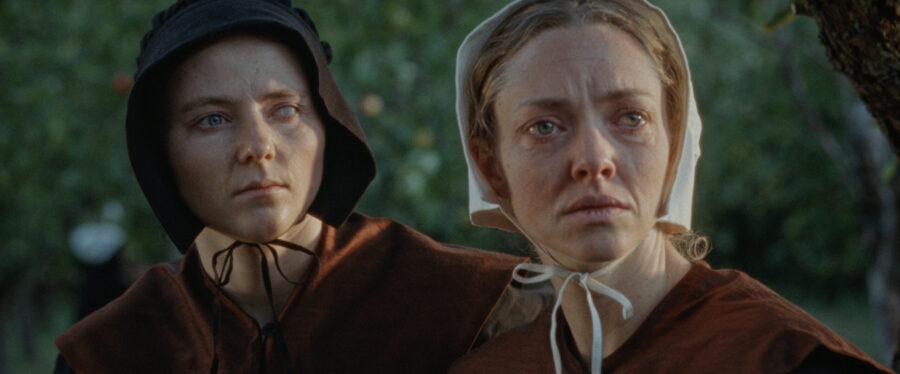
MF: I wanted Manchester to feel like you still have one foot in medieval times—animals and humans sharing space, before Victorian cleanliness; properness hadn’t happened yet. There is a looseness, a bit, to how everyone is living. So we wanted that messiness. It was farmland. We put animals everywhere—goats, chickens. I wanted messiness. At the same time, more grain, torturing the negative, leaning into paintings of the era, single light sources—everything lit with candles. You feel the heaviness, the looming shadow of Christ’s Church, the lack of freedom they had and freedom of expression as well. Then, when we moved to America, psychologically I wanted openness with a lighter color palette, tighter grain and open vistas. And slowly emerging into Shaker symmetry—from that sweaty, messy Manchester rave party into precise order and organization. And there is some polite society as well.
CF: You made this movie for not much money. It’s a period piece about a kind of an arcane subject. You just mentioned that you had a bit of a hard time getting financing.
MF: Yeah, it’s challenging.
CF: It seems like this is the eternal struggle of someone in your role who strives to create actual art. I think a year ago, Brady said something about even his fellow directing Oscar nominees struggling to figure out how to make a living. Is that just part of the acceptable bargain as a filmmaker if you want to make a film that is like The Testament of Ann Lee versus go off and make a Marvel movie or a romantic comedy for Hollywood?
MF: Yeah, I think for me it’s just the only option. And that is actually contrary to what someone might believe—it’s really hard work to go and make a Marvel movie or a romantic comedy. Those directors are working their asses off and not coming home for dinner or seeing their kids, and spending years of their lives doing that. I’m sure there’s great financial gain at the end of it, but for me, I can only do this. That’s the only thing I can do for my soul and my heart. That’s the only thing that’s worth it—to be away from my daughter, my family, to not see my mom and dad for Christmas, things like that; the sacrifices that you make. It wouldn’t be worth it for the money, fame or acclaim of doing a really big commercial project. I couldn’t justify that to myself. And that’s no judgment on anyone who does that, because that’s amazing. But for me, the only way I can justify not being with my family and my kid is because I love it. And I tell that to her—because when she was younger, she’d say, ‘Why do you have to leave again to make this movie?’ And I’d say, ‘Because I love it, and I really, really need to make this movie. That’s why I’m leaving.’ It’s not because I have to make money. Of course I do, but at the same time, I’m doing it because I love it, and that’s the driving force for me.
So yes, it’s going to be challenging, because the stories that I want to tell are challenging. That’s just how it is. But I do have some lovely, wonderful partners—like my producer Andrew Morrison—and some incredible people who support our art and want to continue making it with us. And when we have a film like The Brutalist that actually communicates with a larger group of people, it’s incredible. It feels like a small miracle. Of course, I want to communicate with people. I don’t try to make difficult films on purpose—it’s just that a story calls to you and you have to go on the ride with that story. It doesn’t feel like I have a choice. I can’t sit and think, ‘What will people be into?’ or ‘What will sell?’ I don’t know how to do that. I only know how to tell these really super specific, at times peculiar, stories.
CF: I think the thing with a film like this—maybe 20 years ago, when the art house was thriving differently, many more producers and distributors wanted to scoop up films like this one. So it just seems it’s getting harder to make films like this.
MF: Yes, much harder. But I also choose to make them independently so that I have absolute control over the film. And now, obviously, I’m lucky enough to find a partner like Searchlight, who’s just like, ‘Yes, 100%, we want to come along on this journey.’ For me, the freedom you have when you work independently is important, so that’s a choice as well. Some studios do support radical artists and arthouse filmmakers, for sure. But I do think that what Brady and I want to do at times—it’s hard. I don’t know what I’m saying, actually. I think I really love just doing things exactly how I love doing them and knowing that the film is that.
CF: Your composer, Daniel Blumberg, won an Oscar last year for his work on The Brutalist and he makes a similarly powerful contribution here. Maybe it’s a cliché to say music is a character in a movie, but Blumberg seems a great collaborator. There is so much unique music in this film. How did you negotiate that with him?
MF: I think ‘negotiate’ is the wrong word, because it’s such a true, beautiful collaboration. We worked very closely together on The World to Come, which was his first film score. He was on set and in the edit with me. He’d play his clarinet to the screen and send me two hours of improvisations. We talked about everything. The way we work is unusual. It’s not how a lot of people work with composers. On The Testament of Ann Lee, it was just a continuation of that collaboration. He was the first person we sent the script to. Then we sat down and talked through every scene—what it would sound like, where there’s score and where there’s not. When I finish the script, that’s where we start talking about sound. I don’t say, ‘What instruments do you hear?’ We just talk. And on this film it was human voices, breaths as percussion and body movements as percussion. That was the grounding. Then bells. On the first day we really started working, we were walking around New York City and went into a music shop. We found this little steel bell from the time period, so I bought it. That’s the bell that opens the film and runs throughout the whole movie. In the fire scene at the end, there are just hundreds of bells—the crescendo overtakes everything. When I first heard them, I thought, ‘Is someone ringing in my ears?’ It was painful, but such a cool motif. We start by painting those broader ideas and then we work very finely. We had to find the songs—there are a thousand Shaker hymns—so we dove into that music for a couple of years, really understanding it. Daniel wrote beautiful original songs, too. We found the pieces that belonged in our film, adapted them, rewrote them and changed them. It’s a really symbiotic relationship.
CF: I do hope we can get a soundtrack. Before we say goodbye, I just want to tell you how much I love Vox Lux, which is a movie that’s really stuck with me over time. That character, so troubled and so talented, and the dichotomy of what’s happening off stage psychologically versus on—made it such a fine film, as well as Natalie Portman singing those songs.
MF: Thank you! Thank you. Yeah, I love Vox Lux. I feel it’s really found its audience over time. I meet people who say, ‘That soundtrack—gosh, I love the songs.’ They’re great.
CF: What’s the best part about your job as a filmmaker?
MF: I think it’s those moments on set when we’ve spent months and months rehearsing, working on these complicated shots and ideas and dreams that we have. And it was very hard to pull the financing together for this film. It was also really challenging to shoot—physically challenging. But then you have these moments where all of a sudden there are 200 dancers in the woods, moving together the way you want them to with the camera moving the way you hoped it would, and the performer, Thomasin (McKenzie), actually landing on her mark at the end and delivering that line so perfectly. You have those moments where all of a sudden it comes together, and you’re just a spectator. You’re just watching the movie behind the monitor. You’re not tweaking and moving and trying to be the good conductor. You’re just sitting there and saying, ‘That’s what I wanted to watch.’ And those are incredible moments. That’s just pure ecstasy and joy for me.
This interview has been edited for length and clarity.