By now we well know the story of Kiss of the Spider Woman, which has been around in various incarnations for the better part of a half century since Manuel Puig first published his award-winning 1976 novel. But what a story it is, and its historical context—resistance fighters, artists and dissidents made political prisoners by the state-sanctioned terror—feels, well, timely.
Puig’s award-winning tale of a pair of doomed Argentine cellmates who form a powerful bond during the country’s Dirty War (1976-1983), was set in Buenos Aires’ notorious Villa Devoto prison. In 1985 Hector Babenco transported Puig’s story to Brazil, crafting an art-house touchstone starring William Hurt (who won the Oscar), Raul Julia and Sonia Braga. And in 1993 the property underwent yet another transformation, becoming the hit Broadway brainchild of Terence McNally and the legendary Kander & Ebb (Cabaret). Now comes Bill Condon’s movie version of the Broadway award winner—an adaptation of an adaptation of an adaptation, dressed in lavish production numbers and featuring one Jennifer Lopez, singing and dancing her heart out (in the role that won Chita Rivera the Tony) in a bid for big screen musical cred.
If you’ve only seen the 1985 drama, Condon’s adaptation of the musical will feel like an entire departure tonally, and the Dreamgirls helmer prioritizes his super-saturated production numbers, spectacular costumes and intricate choreography; clearly he wanted to see the Broadway numbers to come to vivid life on a 40-foot movie screen, and on a technical level the film is an unqualified success. But does it sell the central dramatic premise of its unlikely prisoners reaching intellectual, political and sexual symbiosis? Partly.
For half a century, the story’s bones have remained the same: in a dank, claustrophobic prison cell, flamboyantly gay window dresser Luis Molina (a very good Tonatiuh), sentenced to eight years for accused sexual impropriety, finds an unlikely companion in leftist revolutionary Valentín Arregui (Diego Luna). While loquacious Molina idolizes screen siren Ingrid Luna (Lopez), whose posters hang bedside, Arregui is a private, Lenin-reading, hardened radical. The catch: Molina has been placed there by the regime’s warden (Bruno Bichir) to extract political information—the only path to his release.
Arregui is initially put off by Molina’s flagrant gayness but somewhere amidst the mens’ regimens of loneliness and torture develops a primal need. This emerging trust is the crux of Kiss of the Spider Woman, which takes place both in the reality of the prison and the unreality of one of Luna’s most famous pictures, Kiss of the Spider Woman, a dark melodrama featuring Lopez’ platinum Dolores Del Rio surrogate. As the men while away the hours, Molina vividly recounts the picture line for line, spinning the saga of the femme fatale Spider Woman (also Lopez), a vamp whose kiss can kill; she’d be right at home in a shadowy film noir. These musical sequences free the film from its claustrophobic locale, functioning as “escapes” in which both actors appear as handsomely Golden Age movie stars. Yet while the men compete for Luna in the movie melodrama, “offscreen” they become far closer to each other.
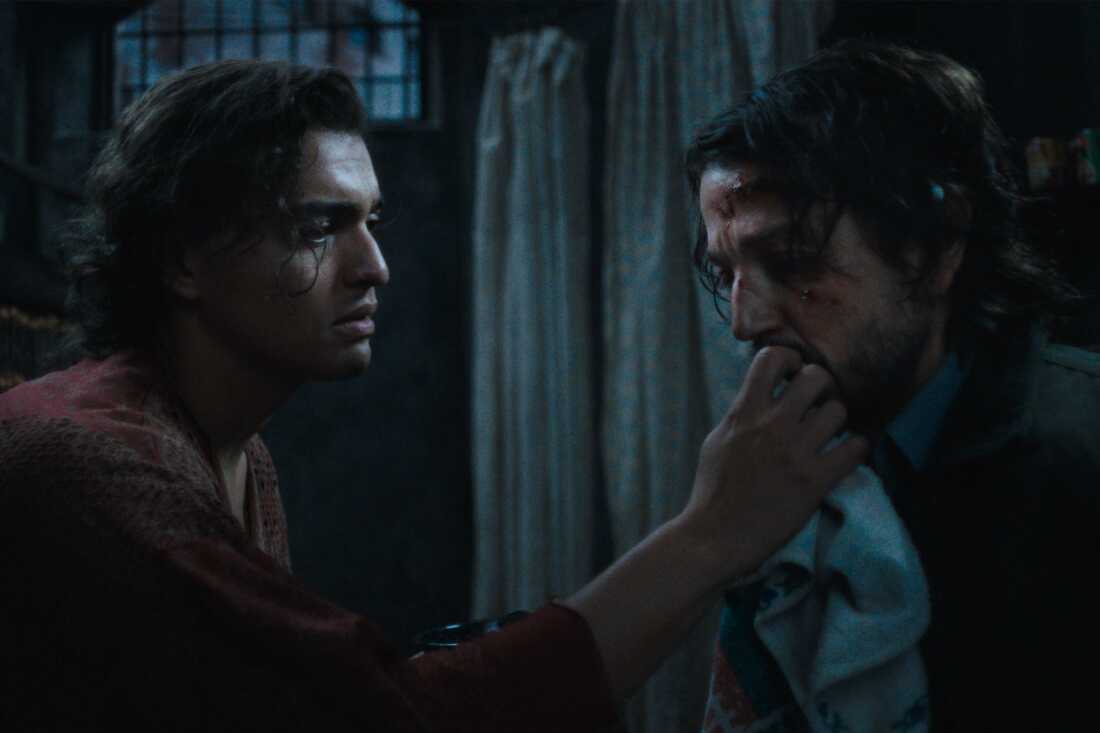
If we believe the central relationship between Molina and Arregui, then we believe the film. Yet Kiss of the Spiderwoman often feels contrived, at least through its first half. Tonatiuh, otherwise excellent, slightly overplays Molina’s camp theatricality early on, while Luna, a capable and nuanced actor, can’t escape comparison to Julia’s gravitas in Babenco’s version. Both leads also appear slightly youthful (though their ages are close to Hurt and Julia), which can lend their exchanges less weight than they deserve. During several of their early moments, my attention drifted—wondering when the next fantasy sequence might arrive. All the necessary pieces are in place: talented actors, a sturdy script by Condon and McNally and observant notions on the spoils of authoritarianism. Yet it takes awhile for these elements to congeal, and the film’s first half sometimes feels curiously by the numbers.
Lopez, whose screen talents are consistently undervalued, is a huge star/brand; we almost can’t see her in a picture now without imagining her turbulent celebrity. But she always delivers. This time, Condon gives her a real chance to prove herself, not as a fine actress which was established decades ago, but as an accomplished vocalist. As Madonna did in Alan Parker’s 1996 Evita (a role Lopez coveted), the star is a stronger singer here than we’ve ever heard her, the payoff of months of extensive song and dance coaching. At the same time, the songs (among Kander & Ebb’s lesser efforts) are oddly bland, undercutting the story’s themes of refuge in art (I couldn’t get lost in any of them).
And while not playing a traditional character given that Luna is a cipher who only exists in Molina’s recitations, Lopez is an undoubtedly an eyeful (and earful). She is also hamstrung by an inescapable artifice, her starlet and Spider Woman purely symbolic and never allowed to become human. One wonders what might have happened had the paroled Molina met his idol in reality, blurring the boundary between life and art and uncovering something truer in the process.
Molina remains the reason the drama works, making the shifts between larger-than-life moviedom and hardscrabble reality believably poignant. Tonatiuh steals the picture (even from Condon) as Molina grows increasingly complex in his affections and ultimate radicalization. With his strong jaw and wide shoulders, liquid brown eyes and a confidence usually reserved for more seasoned actors, he plays every note of defeat, hope and tragedy. It’s a remarkable showcase for the thirty-year-old American actor, born to Mexican immigrant parents, and one that should guarantee his rise to leading-man status. Luna, in the less showy role, is reliably steady.
Condon, who wrote the screenplay for Rob Marshall’s Best Picture Chicago and directed Dreamgirls to an Oscar for Jennifer Hudson, made his best film in 1998’s Gods and Monsters. In the mixed Kiss of the Spider Woman, he nonetheless stages a powerful final act (highlighted by a clever use of Paul Schrader’s lushly erotic 1982 thriller Cat People) from the story’s political thriller climax, culminating in a stirring final image. It’s just a shame the rest of the film doesn’t quite reach that same level, or match Tonatiuh’s remarkable depth. He’s better than the movie around him.
2 1/2 stars