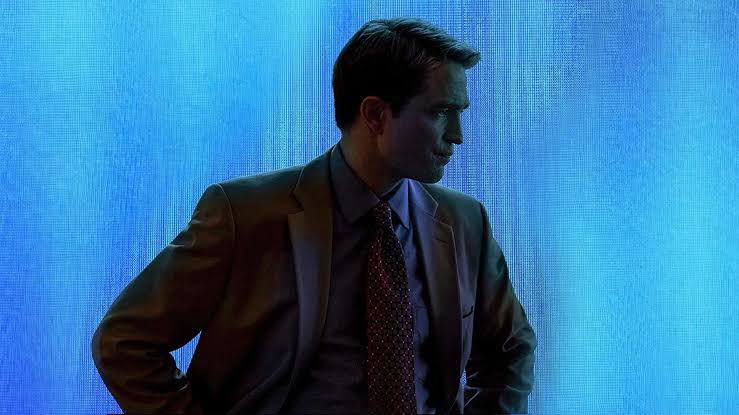
There is something decidedly unsettling about Lance Oppenheim’s Primetime, which turns one of television’s seediest spectacles into a slick study of the people who turned it into ratings. He’s taken a notorious subject and fashioned it not as a critique of its criminals, but of the people who made livelihoods and entertainment out of them. By the time his movie gets where it’s going, what’s most fascinating is how completely the show sweeps its players into a darkness that provides ironic clarity to each.
Powering Oppenheim’s lurid exposé is Robert Pattinson as a semi-fictionalized (which Hansen has disavowed) version of former reality-TV journalist Chris Hansen, the creator and host of NBC’s child-molester sting “To Catch a Predator” segment of “Dateline NBC,” which ran for three seasons two decades ago and has since become an online cult phenomenon. First-time screenwriter Ajon Singh based his story on a 2007 Esquire article (“Tonight on Dateline This Man May Die”), and here delivers a fanged glimpse into the calculations that fueled the show and a study of a man whose ambition and follies are consumed by dogged ideologies, in pursuit of both evil and market share.
If you’ve seen “To Catch a Predator,” you know it’s essentially a one-trick pony in which Hansen and his hidden-camera crew trap and shame online predators during attempted liaisons with what the men believed were underage targets. I confess to watching many an episode on YouTube, and it produces three visceral reactions—revulsion over attempted crimes, relief over arrests and discomfort at the humiliation of it all. Sure, there were chuckles when the men insisted they meant no harm and merely wished to “mentor” their targets, but there was nothing funny as they realized they were headed to prison and their ruinous crimes were about to be televised.
Pattinson positively excels at these secret set-ups early in the film as we meet his Hansen—who apparently has balls of steel—furiously memorizing sexually explicit chat logs as if about to step onto the Broadway stage, only to regurgitate them during “Predator”’s confrontations, here tinged with uneasy humor. Hansen’s famed “Why don’t you take a seat right there,” the opening salvo in many a carefully choreographed interrogation, finds the star mastering Hansen’s ice-cold-under-pressure composure to a science.
The picture opens on a sting operation early in the program’s run, where we meet its major players—Hansen, a high-hopes rising journalist who in real life covered international child sex trafficking and 9/11; TV producer Andie Bender (a sensational Merritt Wever), an expert at packaging the creepiness; Del Harvey (Phoebe Bridgers), a “decoy” convincing as either an adolescent boy or girl; and pervert prospector Matthew Maher (Xavier Von Erck), a computer nerd trolling the dark web for child exploiters the crack team can nab for their next episode.
And then a recruit galvanizes the dynamic. Enter ambitious Dan Plumb, a struggling early-20s actor with just one commercial credit but who can sing an a cappella rendition of Rent’s “Seasons of Love” (an absurdity used here twice), and he’s played by the terrific Skyler Gisondo, stepping up to the plate (and into the fire) as the show’s naive new decoy. Initially, Dan has a ball with his improvisational new gig, raising his voice to a higher octave and deploying genuine awkward teen innocence. But once the show makes him semi-famous, he’s in for a reality check as acting, proximity to danger and conscience intermingle in unexpected ways.

While the NBC brass doesn’t like what Hansen and team are producing, the viewership is there and so, soon, is the coveted Wednesday 9 p.m. prime-time slot against ABC’s hit “Lost”. But Hansen, envious of the dismissive and esteemed Stone Phillips, wants to be seen as an equally serious journalist.
The first hour of Primetime is well-acted but doesn’t seem to have much to say. It’s not exactly an indictment of the audience for consuming crime as entertainment, nor an exploration of the show’s endurance; both rather low-hanging fruit. And it isn’t critical of the network, even though the show was accused of entrapment and sued to the tune of more than $100 million in a wrongful death suit. And it isn’t about how the troubled Hansen would later face his own real-life legal and financial troubles.
But in the picture’s second half, things begin to snap into focus as we get closer to the spiraling Hansen, who shares a formative investigative experience with Dan—one in which he was following a story about India’s child labor that led to a confrontation with what he believed to be an “ancient evil” entity, a life-changing encounter that set him on the path to rooting out darkness and which would become his raison d’être for the series.Hansen’s recitation of this anecdote and belief that what he’s doing is indeed a higher calling, or a higher form of journalism than mere reporting, may be his source of truth. But it’s also a late-film pep talk to the faltering Dan: “What you’re doing here is more than acting: you’re cleansing the world from an ancient evil.”
This is good, dark-matter stuff, and the movie ratchets up that intensity in its later passages, excavating a pair of “Predator”’s highest-profile controversies, including the shock confrontation with soon-to-be-convicted Rabbi David Kaye, mounted here to force an ethical question (“You don’t have the right to do this!”) and shot in close-up with tension equal to the real-life encounter.
That question also sets the stage for the film’s protracted final sequence, as the team chases a “big fish” lead all the way to Texas. Meanwhile, Hansen’s personal life collapses (Anna Farris appears briefly as his long-suffering wife and mother of their two children) after being outed in an affair by the National Enquirer, while Bender entertains a lucrative offer to join a competing reality show. Amidst all of this, Dan loses the plot and himself. That big fish in their net is based on the real-life suicide of Dallas-area assistant attorney general Louis Conradt (here named Bill, and played by Bill & Ted alum Alex Winter), who took his life just as police arrived at his home. This is strong, high-stakes stuff.
The film’s heavily pronounced visual style is another matter; one might even say overdetermined. David Bolen, who shot last year’s out-there documentary The Python Hunt and 2024’s Thelma, gives the movie an absolutely garish, even ghastly look, with high-contrast, super-saturated, grain-filled cinematography in nearly every shot. This approach is abjectly artificial, the furthest thing from any sort of objective reality. It is a hot-house, overheated, ripe-looking movie, so visually exaggerated that it took me almost an hour to settle into the story proper.
What the movie does have is three interesting characters circling a morally dubious morass that turns each of them upside down. While Hansen sees himself unravel in a pressure cooker of adultery and a feverish desire to sustain ratings, Weaver’s Andie is a shrewd-as-hell operator who cares only about the success of the program, whatever the cost. Every moment she’s on screen is compelling, and Weaver deserves serious Oscar supporting consideration. Early in the film, she reassures a shaken Dan that he’s had a good first day on the job: “You’re a star.” Later, when it looks as if Hansen is going to tank their entire enterprise, she towers over him, grabs him by the collar and issues a directive in such a distinctly original voice that it becomes a genuinely memorable bit of performance.
And perhaps equally complex is Dan, the unsuspecting young star who gets a shot at the big time and takes it. For a while it’s fun and games, but there is a cost, and Gisondo adroitly conveys Dan’s own brand of innocence lost; even though the age deception is a ruse, his character recalls a long line of young Hollywood neophytes playing (too) grown-up on screen and later paying the toll. His final scene cleverly considers the cost-benefit trade-off.
If Primetime doesn’t necessarily have all that much to say, it’s solidly entertaining, with good performances and a director venturing into territory that is both blackly amusing and genuinely unnerving.
3 stars