This movie season has given us three sensational political thrillers including Jafar Panahi’s battle cry against Iran’s theocratic regime in the Palme d’Or winning It Was Just an Accident andKleber Mendonca Filho’s The Secret Agent rebuke of Brazil’s military dictatorship and its power to assassinate the lives and legacies of opposition.
Now comes Kaouther Ben Hania’s urgent The Voice of Hind Rajab, a work of emotional plutonium in which Palestinian emergency responders attempt to save a six-year-old life from the Gaza crossfire. It is, by far, the most emotionally immediate and gripping movie of 2025; forget the Hamnet histrionics, because Ben Hania’s piercing picture shakes us with a primal force. You may cry, yes, but you’ll also be stunned into silence minus any contrived catharsis. As you should be.
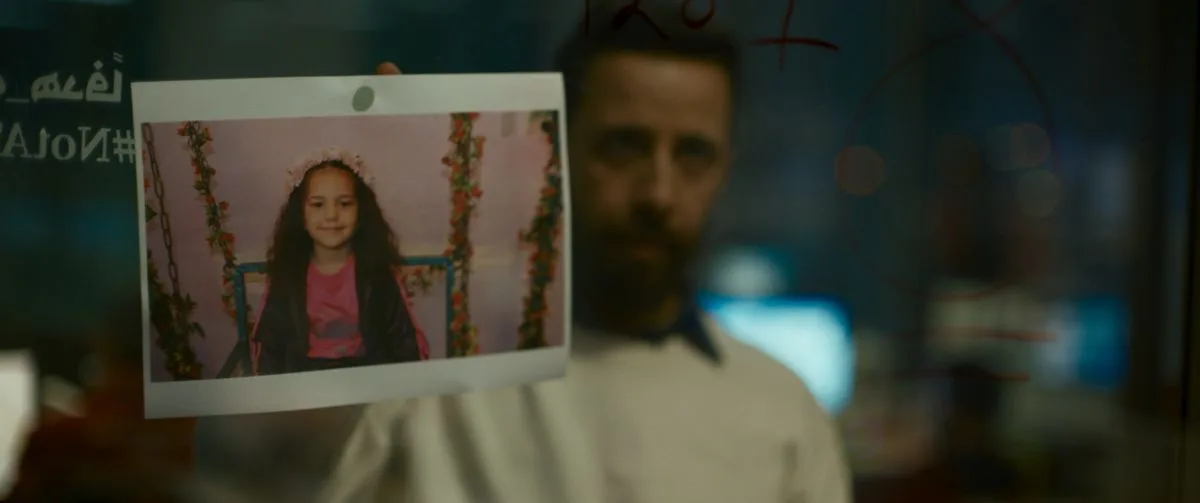
Tunisian director Ben Hania (Oscar-nominated for 2020’s The Man Who Sold His Skin) crafts this harrowing real-life story—a cry for help from a young Palestinian girl first orphaned, then trapped on a battleground—by blending public record audio recordings and scripted performance in a movie as intense as they come. The facts of the incident are known: on January 29, 2024, emergency workers in Palestine’s Red Crescent rescue operations received a call from one Hind Rajab, pleading for help after her family’s slaughter. Hours later, she would sadly join them—this after well-meaning workers and a too-late ambulance failed to rescue her. Ben Hania’s shrewd, compassionate movie is neither polemic nor documentary, rather a high-stakes, single-location pressure cooker fight to save the life of a child.
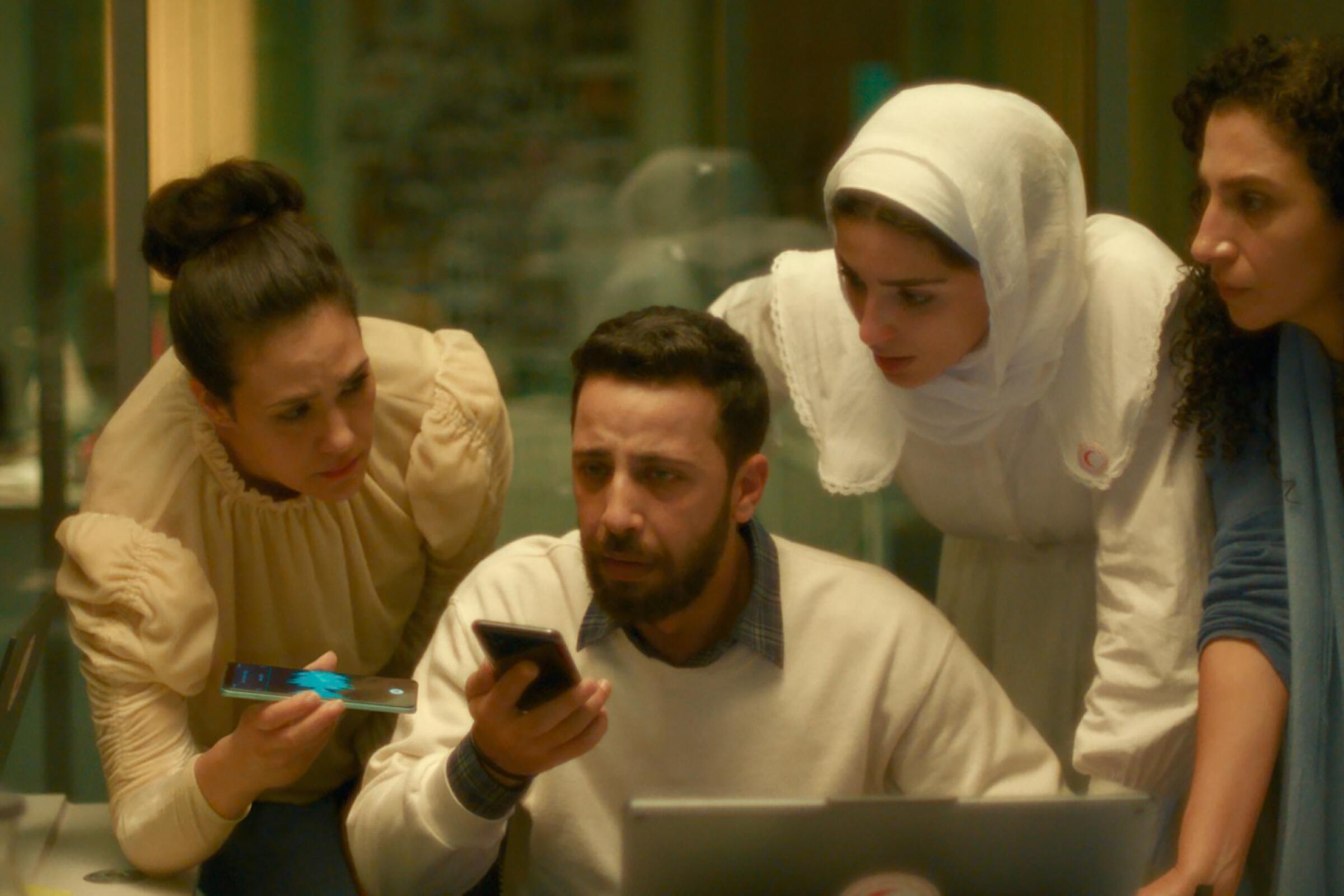
It begins like any other day, as Red Crescent dispatch center workers are winding down or starting their shifts. A cursory set-up introduces us to Omar (a riveting Motaz Malhees), the kindly intake operator and first to hear Hind’s voice on the line with a terrifying story: some fifty miles away in Gaza City, she’s a sole survivor, hiding beneath the dead bodies of six relatives killed by shellfire before they could escape the war zone.
Omar quickly loops in support from colleague Rana (Saja Kilani), and they take turns keeping the girl on the line and calm while attempting to get an ambulance—some nine miles from the girl’s location—to the rescue. This is far more difficult than it would seem, and as minutes turn into hours, Ben Hania ratchets pulse-pounding tension from whether Hind will survive (the soldiers are literally upon her), wholly dependent upon a gauntlet of almost insurmountable protocols (part safeguard, part bureaucracy) triaged by didactic supervisor Mahdi (Amer Hlehel). The terror here is in the helplessness—hearing a child’s pleas for survival tangled in red tape. That tape, designed to protect the lives of first responders in extreme danger with every attempted extrication, makes for an excruciating, lose-lose situation.
The drama at the call desk is spellbinding. The more infuriated Omar becomes at Mahdi’s insistence (and frequent calls with the Ministry of Health) to wait for approval to send in paramedics, the more emotional Rana becomes; a kindly psychiatrist named Nisreen (Clara Khoury) attempts to soothe the girl but the situation only becomes more heated; at a certain point there’s no talking the child down from what everyone knows is coming.
Because the picture deals with a child in peril some will undoubtedly assert manipulation, but Ben Hania is so incisive her movie remains largely free of melodrama, even when its writ large human emotions are on its sleeve—and on the worker’s faces that fill the screen; our identification with their deep anguish over an outcome they fight desperately to circumvent is as strong as our empathy for Hind. Seeing their torment while listening to her abject fear creates a ferocious, inexorable crescendo.
In The Voice of Hind Rajab, Ben Hania crafts a movie that transcends its form—whether narrative, documentary or merely a suspension-of-disbelief movie—to cut right through artifice and into something that is both a call for attention and action. What happened to Hind Rajab was an unfathomable tragedy, and the movie (which struggled mightily for months after its Cannes debut to secure distribution) asks us not to merely consume its story, but rather to witness, for 90-minutes without release, the fate of just one of thousands of children lost in Gaza.