In Bing Liu’s Preparation for the Next Life, a young woman and man cross paths by chance in New York City and soon plunge into a love that will be tested, though not always in the ways we might expect. That couple—an undocumented Uyghur immigrant and a recently discharged U.S. Army veteran—share plenty of chemistry and feeling. Yet, as the saying goes, you can’t live on love alone, can you?
It’s not that they don’t give it their all, and it would be tough to find another pair of screen lovers this year as endearing as Aishe (newcomer Sebiye Behtiyar) and Skinner (Fred Hechniger), who spark instantly after a chance glance on a street corner. If it isn’t quite love at first sight, it becomes one soon enough—a fast, deep bond that carries them across New York City in an adrenaline-fueled rush of courtship. For two people so different, they fit together, at least initially, with striking symmetry.
But do their troubles cut deeper than their bond? Aishe, the daughter of a Uyghur soldier, is sharp and resourceful yet stuck working brutal hours in Chinatown kitchens where she’s practically invisible. She knows her worth, but still gets paid nothing while pushed into the hardest jobs. Honed by her endless workouts (she can give Skinner a run for the money in push-up contests) she keeps moving, but her barrier isn’t lack of effort of will to become. As she tells Skinner, it’s “how I came here,” which, in her own words, leaves her with “no identity.”
Behtiyar, a recent graduate of the Savannah College of Art and Design, is a remarkably skilled performer who knows that less is more, and holds the camera like a mirror. What it reflects is a remarkably quiet, moment-to-moment evaluation of this relationship, which the actress captures in an array of subtle expressions. As for Skinner, played by Hechinger with a quiet kindness in his eyes that can just as quickly turn to flashes of aggression or deep depression, he carries his own burdens. His PTSD is crippling, and with his discharge comes the loss of medical care. He has little motivation to do anything besides workout, convinced his slight frame will one day match the pumped up bodybuilders he so reveres in fitness rags.
Faced with burdens this heavy, how are these two to hold onto love? Isn’t this supposed to be the best time of their lives? If any of this sounds heavy-handed, rest assured it is not—Liu and his Pulitzer Prize-winning playwright screenwriter Martyna Majok avoid all pretenses of the didactic. When the film’s social-issue underpinnings emerge as grave obstacles, the picture never swerves to easy indictments of, say, a broken immigration system or a insufficient veterans’ mental health resources.
Instead, in adapting Atticus Lish’s 2014 novel, Liu and Majok eschew polemic in favor of people. The first hour builds such an appealing relationship that it’s exhilarating; even enchanting. Moments like a Corona drinking contest in a Mexican bar that ends in a first kiss to Jose Luis Perales’ ballad “Un Velero Llamado Libertad” (reprised later to poignant effect), or a mad dash to consummate their union in “the closest hotel,” feel utterly romantic. But life has a way of intervening cruelly, and when it does, rarely have we rooted so strongly for two movie characters to stay together.
Liu, who earned an Oscar nomination in 2019 for his personal and powerful documentary Minding the Gap, again taps into something potent: young people stepping into an adult world for which they are both unprepared (Skinner may have gone to war but knows nothing about love) or disadvantaged (Aishe lands in immigration detention, fearfully seeking to adjust her status through marriage, a precarious option at best). In the end, the future they may be seeking is unlikely to be the same. Aishe’s defining strength is her iron-willed determination to keep moving toward an American dream that may not be hers—but that doesn’t stop her. Skinner, on the other hand, is just trying to get out of bed each day in the “four wall” Queens basement apartment the pair calls home.
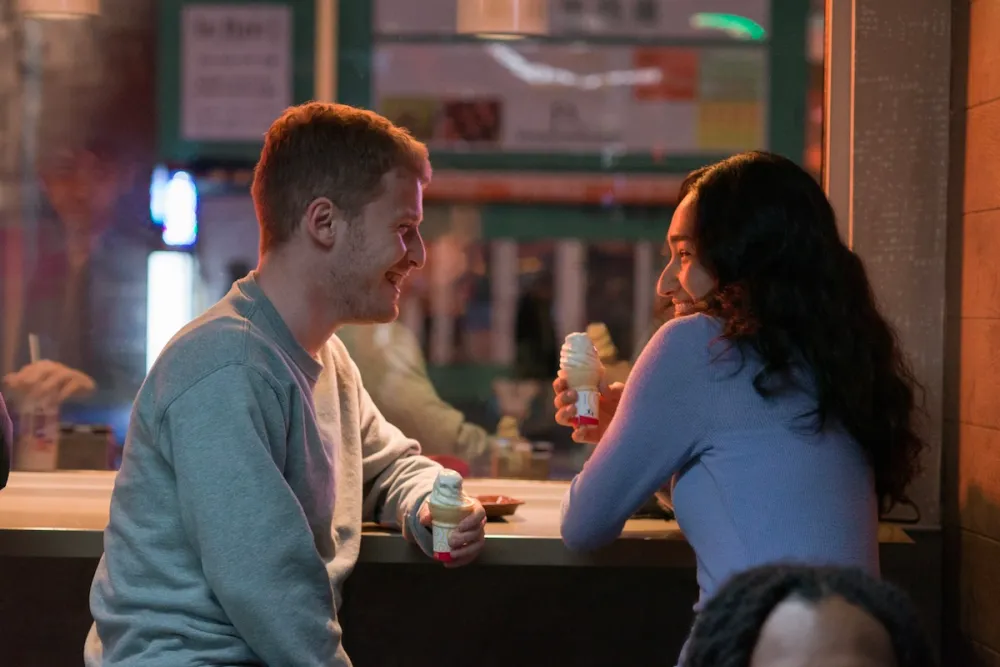
The film is, at times both swoon-worthy and deeply sad. I’d be lying if I said I didn’t lose my heart in its opening hour, a very fine evocation of young love and to-be-thwarted idealism. In shot after shot, Liu and cinematographer Ante Cheng (assisted by Emile Mosseri’s romantically propulsive synth score) frame their lovers as an “us against the world” force—whether the camera hunts for them in a crowded McDonald’s over ice cream by disappearing everyone else in the shot, or sitting quietly together in a Queens window sill, gazing at the Manhattan skyline. That they belong together in that room is obvious—but is there a place for them outside in that city of eight million?
Preparation for the Next Life is a gorgeously shot, quietly moving film, centered on two characters you can’t help but care for. It’s that rare kind of special.
3 1/2 stars